PhD Portrait: Selçuk Parlak
Lighting Up the Future, One Material at a Time
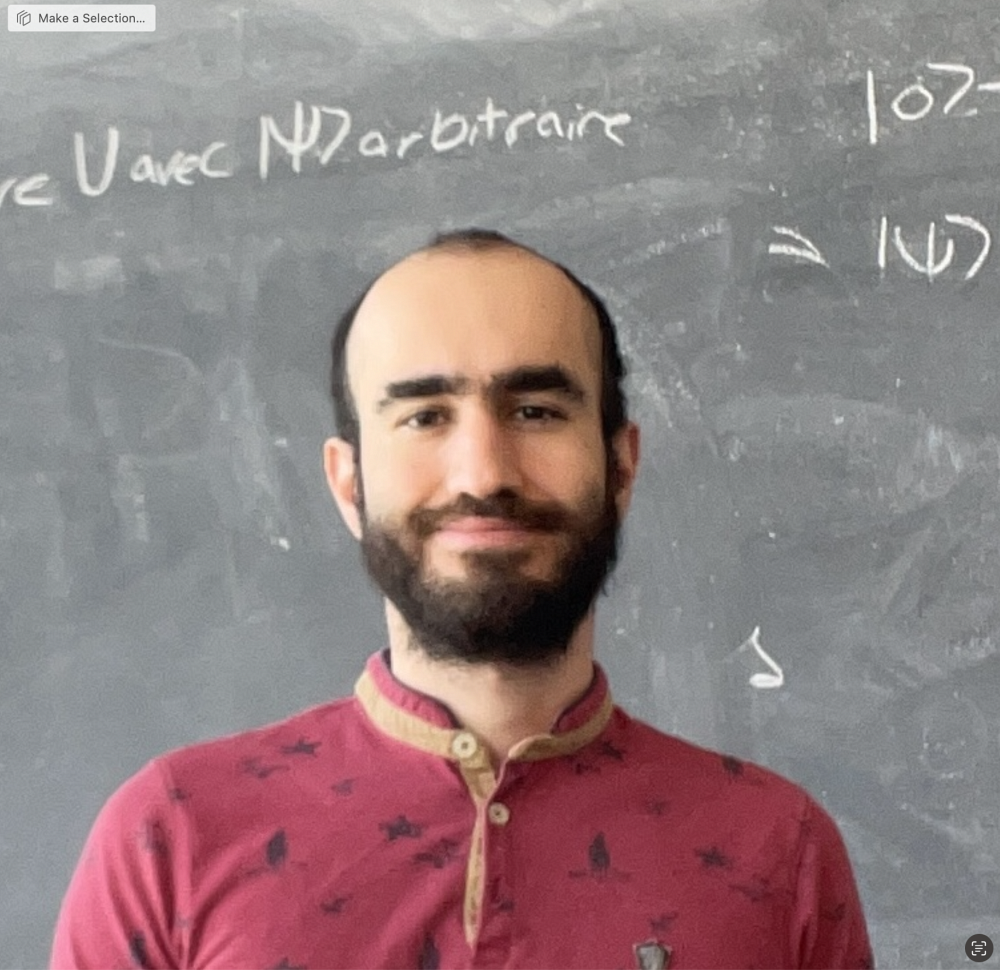
On June 8th, Selçuk Parlak defended his dissertation in the Institut quantique (IQ) auditorium.
He completed his undergraduate and master’s in physics at the Bilkent University, Ankara in Turky. He was inspired to come in Canada in 2022 after seeing Professor Ion Garate’s research. In fact, Selçuk mentions the fact that he was one of the many reasons he decided to pursue his graduate studies at the Quantum Institute. Professor Garate was and continues to be a real source of inspiration for Selçuk.
According to Selçuk, IQ is an ideal place to thrive academically.
Every professor is open for collaborations, and very willing to teach you something new. Any student there from undergraduate to postdoc can learn a vast variety of topics just by the sheer number of presentations that occur in the auditorium of the institute.
His theoretical work focused on realistic experimental setups. When asked, Selçuk gives us the following analogy to illustrate his research:
Imagine you’re on a beach, gazing out at the ocean. The water forms a gentle wave rolling toward you. The wave has a direction and carries energy with it. A similar wave exists in materials; it’s called a phonon. The sun is shining, and the light reflecting off the ocean glints off you. The light interacts with the sea, which interacts with the wave, and the sea reflects the light back to you. The same process occurs in real materials. When you shine a light (a photon), the photon interacts with the sea of electrons, which interact with the phonons, and the electrons emit a photon. In both processes, the energies of the incident light and the scattered light are not identical. This is called inelastic light scattering or Raman scattering. We perform Raman scattering experiments on materials containing special electrons called Dirac fermions. The goal is to understand how light scatters off these Dirac fermions.
During his time at the institute, Selçuk faces some challenges that he overcomes. He managed to learn and apply a lot of concepts that were foreign to him at first despite the complexity of the task. Furthermore, one of his biggest accomplishments was learning French while focusing on his research.
I think I have learned enough French to get by with day-to-day task and express my emotions. I always find it difficult to learn a language. I am happy that I have taken on this challenge and arrived at the point that I am today.
Selçuk doesn’t limit himself to his research; he likes to expand his horizons and develop new skills. He had the opportunity to collaborate with Professor Maia Vergniory’s group on first-principles calculations which lead him to familiarize himself with a completely different tool and learn to work as a team.
When he thinks of the future of science, he sees his research impact as such:
I believe that at least my project will be a bit useful to the people who work on the theory of Raman scattering. There are not a lot of people working in this field, but for those who do, the results or the methodologies that we have used, will be useful to them. Furthermore, I believe that my work induces some academic curiosity.
Selçuk offers some advice to all future doctoral students:
Make better use of the resources that the IQ provides than I did. Especially if you’re hesitating whether you want to stay in academia or move to an industry. It’s a good idea to enter the mentorship program of the institute to start working towards a goal. What I learned is that there is a lot of people here that will help you if you just ask them.
In fact, Selçuk wishes to thank everyone who has contributed, directly or indirectly, to his journey, but especially his thesis advisor, Professor Ion Garate, to whom he will be eternally grateful for the support he has provided.
Congratulations Selçuk!