Governance
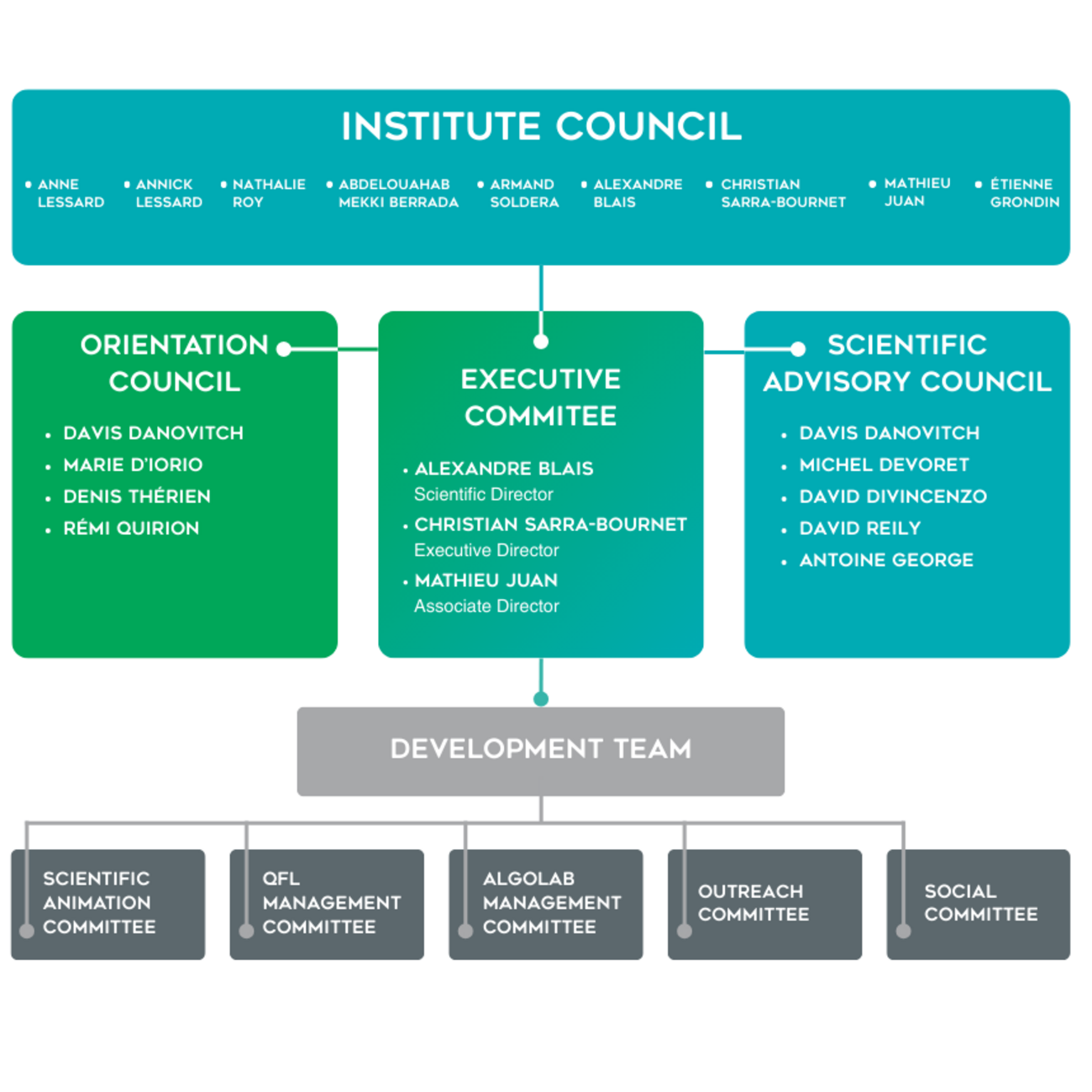
To ensure that Institut quantique is a resilient, high-performance and sustainable organization, and to guarantee that it is managed efficiently, transparently and in line with its mission and strategic objectives, Institut quantiques management has set up a well-defined governance structure.
Governance structure
The institute council is responsible for key decisions concerning the strategic direction and governance of the Institute. It is accountable to the university eexecutive committee through the Vice-Rector of research. More specifically, the institute council reviews and approves strategic priorities and ensures that short, medium and long-term objectives are aligned with the Institute's mission. The institute council oversees scientific activities, approves research priorities and assesses the quality and impact of research activities. The council reviews and approves budget allocations for the institute's projects and activities. The council also oversees the recruitment of new members and appointments to key positions within the institute. Based on regular monitoring, as well as a review of the annual report, the council assesses the institute's overall performance regarding its strategic objectives, and identifies challenges and proposes solutions.
The institute council is composed of members from within the Université de Sherbrooke, including deans of faculties, vice-president of graduate studies, administrative managers and the institute's management.
Composition: Anne Lessard, Annick Lessard, Nathalie Roy, Abdelouahab Mekki Berrada, Armand Soldera, Alexandre Blais, Christian Sarra-Bournet.
The main objective of the orientation council is to provide strategic recommendations to guide the evolution of the institute in line with its mission, priorities and advances in its field. The council helps to define major strategic orientations, identifies funding and partnership opportunities, and provides a long-term vision of the relevance and impact of the Institute's activities.
Its members come from the academic, private or government sectors, and have extensive experience in science administration and policy.
Composition : David Danovitch, Marie D'Ioiro, Denis Thérien, Rémi Quirion.
The main objective of the scientific advisory council is to guarantee the scientific excellence of the Institute's activities and to guide its research directions. The board provides feedback on scientific projects and results, as well as on academic excellence. It also provides guidance on research areas to be prioritized, identifies opportunities for scientific collaboration with external partners, and supports management in its search for collaboration opportunities.
The majority of its members are researchers with expertise in quantum science and technology from outside the Institute.
Composition : David Danovitch, Michel Devoret, David Divincenzo, Antoine George, David Reily.
The executive committee is the Institute's executive body. Its mandate is to coordinate and support the operations required to produce a long-term strategic development plan for the Institute, in consultation with the members' assembly and the orientation council. The committee coordinates the joint actions required to advance the research work of the institute's members, and proposes appropriate actions to achieve the institute's strategic development plan. The committee defines the development team's action plan in terms of information dissemination, activities to stimulate scientific collaboration and scientific leadership. The executive committee represents the institute and its research to government bodies and partners, and takes the necessary action to maximize the benefits for its members.
Composition: Alexandre Blais, Christian Sarra-Bournet, Mathieu Juan.
The development team designs and implements initiatives designed to support the board of directors in its strategic and operational actions for the institute. It facilitates the flow of information between members, research teams and their scientific partners, and stimulates scientific collaboration by organizing activities to strengthen exchanges between researchers.
It is also committed to enriching the student experience by creating a stimulating environment favourable to personal and professional fulfillment, enabling each student to develop their full potential.
Acting as a bridge between the internal community and external partners, the team facilitates interaction and fosters collaboration. It supports technology transfer, encourages the filing of patents and explores opportunities for the creation of emerging companies, promote the discoveries made by members of the institute.
Scientific animation committee
The institut quantique's scientific animation committee is responsible for managing and organizing seminars and the annual colloquium. These scientific activities promote the pooling of expertise and stimulate collaboration between the institute's researchers. Made up of members of the IQ student community, faculty and staff, this committee is responsible for planning, coordinating and implementing these events.
Quantum FabLab (QFL) and AlgoLab platform management committees
The management committees ensure budgetary consistency between the quantum technology platforms. They provide a link with IQ board of directors, presenting budgets and annual action plans. They also encourage communication and collaboration between the platform communities.
The management committees ensure that new platform development projects are consistent with the research themes of the institute quantique. They discuss all platform development projects and can also assist management in defining IQ's strategic orientations, in particular for the implementation of mobilizing projects and infrastructure grant applications. The committees are made up of faculty members and platform coordinators.
Composition (AlgoLab): Stefanos Kourtis, Anne MacKay, and Cunlu Zhou
Outreach committee
The science outreach committee is made up of the Curieux quantiques team and students of quantum science and technology, with the aim of presenting this rapidly evolving field. Activities and workshops are created, developed and run by the committee with the purpose of introducing quantum science to a variety of audiences, from young high school and CEGEP students to school teachers, families and adults interested in discovering quantum science.
Social committee
The IQ's social committee organizes various activities designed to bring the community together, enabling members to meet and exchange views on a variety of topics, both scientific and social. The committee's initiatives are designed to foster the integration of new members, and reinforce cohesion and well-being within the community.
These committees are made up of members of the faculty, student community and staff.