Classics gone quantum: Romeo and Juliet
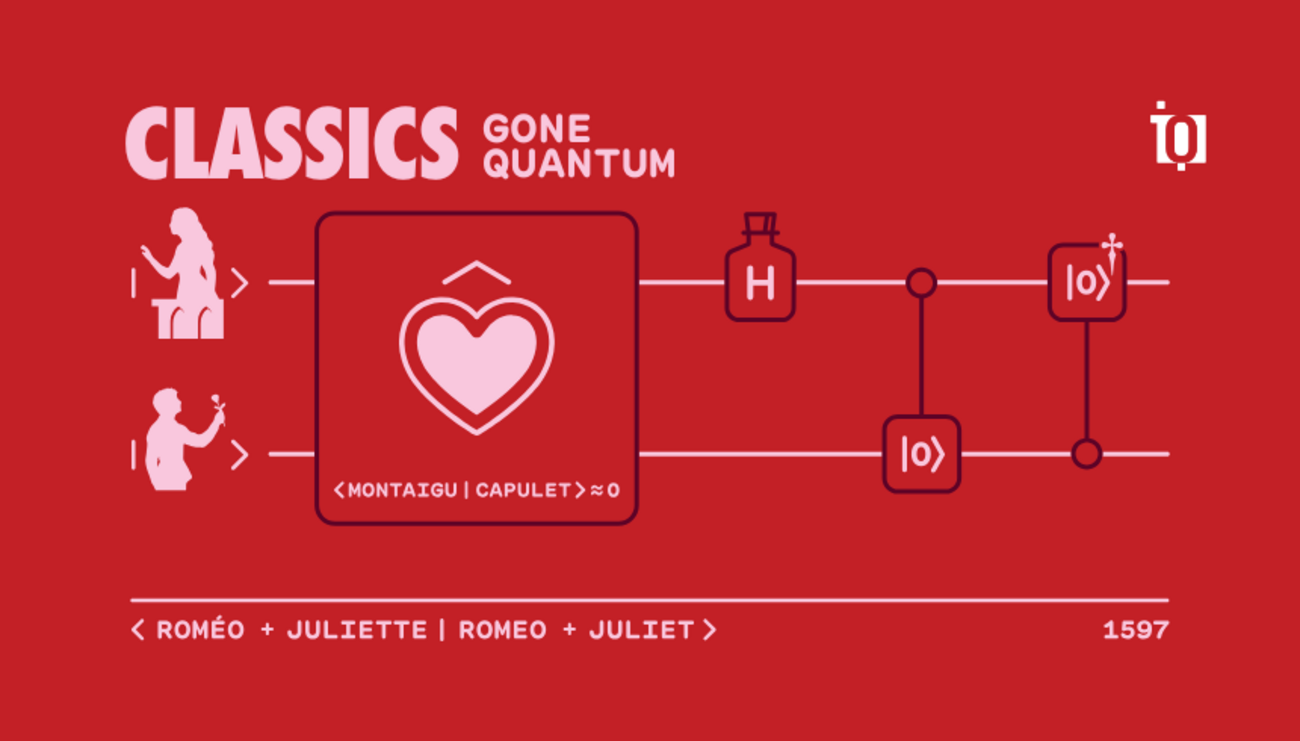
Challenge: Create new quantum gates to represent the tragedy
In what state is Juliet, standing high on her balcony? And in what state is Romeo, who is courting her?
The first box of the algorithm represents all the operations acting on the hearts of the two lovers, deeply affected by the conflicts dividing their families. Orthogonal to each other—that is, practically perpendicular—the Montague bra and the Capulet ket produce an almost zero inner product, making the love between Romeo and Juliet nearly impossible.
In our version of the story, this forbidden love leads Juliet to drink a vial of poison, an act that plunges her into a quantum superposition of states: both alive (state 1) and dead (state 0).
The measurement of Juliet’s state then plays a decisive role in the rest of the story. If Romeo measures her in the “dead” state, he poisons himself as well, ending his life. A two‑qubit gate, as rare as it is unexpected, is here controlled by the 0 state: it leads to Romeo’s death when Juliet is also in that state (0).
At the end of the circuit, if Juliet measures Romeo in the “dead” state, she kills herself with a dagger, through another equally unusual gate: a “dagger reset” gate, controlled by Romeo’s 0 state.
However, even in this tragedy, a glimmer of hope remains… If Juliet is alive (1) at the moment Romeo measures her, he remains alive as well, and Juliet does not take her own life. And since the circuit is never measured, these two versions of the story continue to exist in parallel, in a tragically romantic superposition.
Scientific note
No, a controlled‑reset‑dagger gate doesn’t exist!
To learn more about the different quantum logical gates, watch this video.