PhD Portrait: Marc-Antoine Roux
From Particles to Qubits
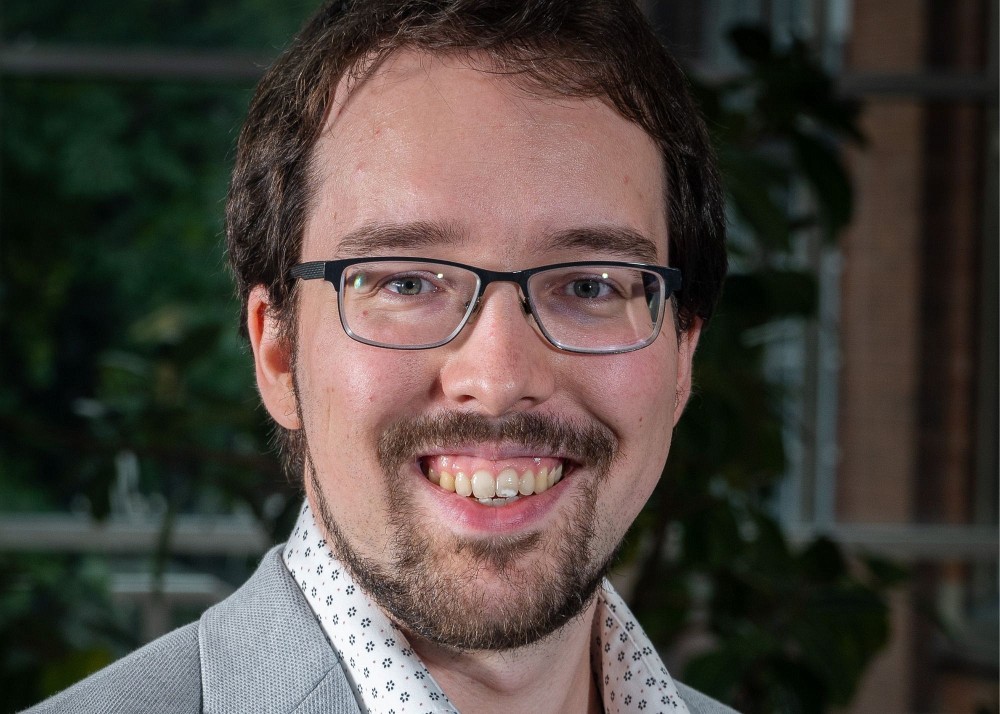
Photo : Photo fournie
On November 28, Marc-Antoine Roux defended his thesis before those who supported him throughout the past few years.
This event marks the culmination of a journey rich in encounters, achievements, and above all, learning :
I’ve gained a lot of knowledge, but I’ve also realized just how little I truly know about physics.
The Université de Sherbrooke, combining sustainable development and cutting-edge physics research, had everything Marc-Antoine was looking for from the start of his bachelor’s degree. However, some might think it was the course IFT339 – Data Structures that truly sparked his interest in quantum computing :
I didn’t know it at the time, but that course would be incredibly useful for my project. It’s ironic that my favorite class during my physics degree was a computer science course… Although, considering I went on to do a PhD in quantum computing, maybe it’s not so surprising that I combined physics and computer science!
After completing his physics degree, Marc-Antoine proudly joined the IQ community. For him, the Institut quantique quickly became a collaborative space, a place where curious minds meet :
It’s so easy to meet people with complementary expertise and exchange knowledge […] It allowed me to broaden my understanding of many topics, like nitrogen-vacancy centers, machine learning, resistive memory, and more.
Marc-Antoine’s time at the Institut quantique also reflects his desire to share his passion with the public. He found his place in student groups, which helped him fully develop his potential as a science communicator :
I got involved with the IQ science outreach committee and the student group Let’s Talk Science. In both cases, I was explaining science to the general public. At Let’s Talk Science, we had to adapt our classroom activities from in-person to virtual during COVID. It was a big challenge, but it taught me how to adapt.
His doctoral research focused on accelerating the startup sequence of a quantum computer. He explains :
The type of quantum computer I worked on is based on spin qubits, where information is encoded in the spin of electrons, that is, their magnetic moment. It’s similar to using the north and south poles of a tiny magnet to store the 0s and 1s of a computer.
Marc-Antoine emphasizes his gratitude to those who shaped his journey :
I’d like to thank Michel Pioro-Ladrière and Eva Dupont-Ferrier for supervising me all these years. I also want to thank Christian Lupien for helping me so often with technical issues in my project. And a big thank you to Michael Lacerte for his help in the lab!
Looking ahead, Marc-Antoine plans to continue his work at the Quantum Innovation Zone, an ecosystem he joined some time ago.
One thing is certain: a bright future awaits him.
Congratulations, Marc-Antoine!