Faculty prize for recognition of the quality of university teaching
An AlgoLab member stands out
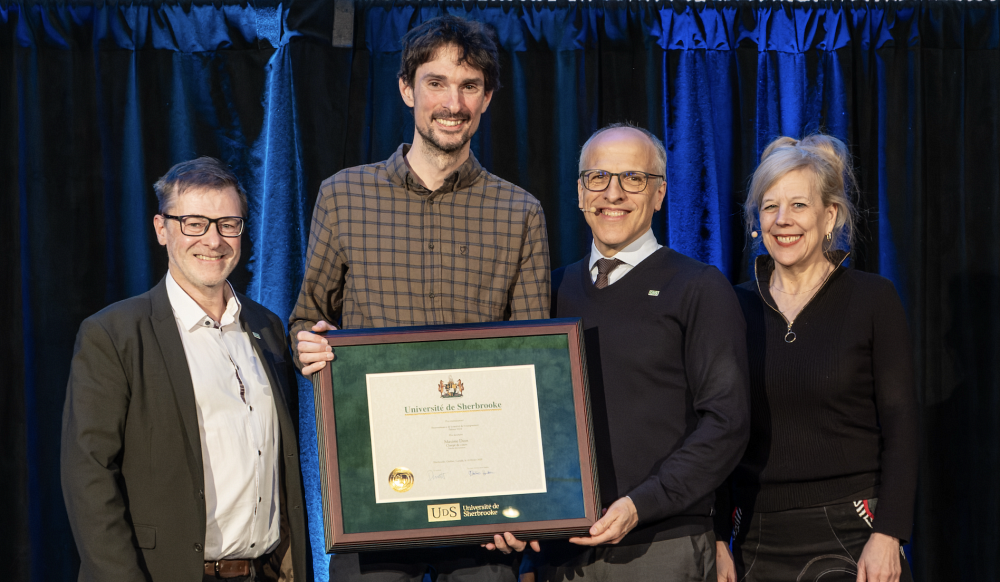
Photo : Michel Caron - UdeS
The UdeS Faculty of Science has awarded its 2025 recognition for university teaching quality to Maxime Dion, a quantum computing developer at AlgoLab and a course lecturer. This award acknowledges a person whose teaching, commitment, support and improvement of university teaching are outstanding. The prize was awarded following a recommendation from the faculty and several positive comments made by students studying in bachelor's degree program in quantum information science (BSIQ).
Maxime is both surprised and visibly touched by this recognition: “I teach intuitively. It's validating in a way that my teaching approach resonates with BSIQ students.” His scientific curiosity for the world around him is obvious to those who encounter him: “I want to share this feeling of having a deep understanding of things, a certain mastery. Teaching is the best way to do that,” he adds.
Making the leap into teaching
This same curiosity was evident from an early age. His first contact with science came when he was eight, on a rainy day at the ‘Les Salines’ day camp in St-Hyacinthe, “on the side of Autoroute 20,” remembers Maxime. My counsellor at the time made us do a simple liquid transfer experiment using paper, blue dye and paper cups. I still remember the feeling of discovery at that age.”
This appetite for science continued throughout his university studies in the Physics department at UdeS, where he progressed to a bachelor's degree and then on to graduate studies. His first contact with teaching came at the master's level, when he was assigned an exercise load. His involvement in teaching continued at the doctoral level, and a combination of circumstances led him to give his first course before completing his studies. “It was a privilege for me to be able to teach, and it was extremely rewarding to receive positive feedback from the students. I also quickly realised that giving a good course takes a lot of preparation!”
In June 2020, he was the first to join AlgoLab's nascent quantum programming team. Along with his colleagues, he was involved in developing a number of quantum computing workshops for CEGEPs. “We quickly realised that it was possible to introduce young people to quantum computing earlier in their schoolingjourney. These workshops and the work I'd done on various quantum programming research projects gave me a certain perspective on the minimum knowledge required to approach and teach in this field.”
Equipping the next generation in quantum computing
At the same time, the new Quantum Information Sciences programme was being set up. Maxime seized the opportunity to put his new knowledge to good use and, along with his colleague Karl Thibault, was entrusted with creating and teaching two courses for the first year of the bachelor's degree in 2022.
“Everything had to be put together, says Maxime. The programme had to offer innovative teaching approaches. We had a mandate, but also the opportunity to use an experiential approach. I didn't really know what that meant, but Karl did!”
In the end, his teaching approach is a mixture of lectures and structuring projects that put learning into practice. He insists on offering a learning environment that is open, stimulating and fun, to keep students on their toes: “When I ask a question in class, I often wait for the unease of silence to build up [a little] before people answer,” admits Maxime, smiling. “When nobody knows the answer, someone always ends up trying something based on their current knowledge. That usually provokes discussions and that's often when the learning starts, and the whole class benefits.”
“It's satisfying to see someone understand. The contact, the interaction with the students and building a relationship, especially in a new field like quantum computing where exchanges are essential. Sometimes students surprise you by asking a question that hasn't been answered yet. I'm not afraid to show the limits of what I know and what I don't know.”
At the same time, he stresses the importance of empowering young people to take charge of their own academic careers: “A common challenge for people starting university is to take ownership of what they learn and how they learn it. The BSIQ helps them develop tools that can be applied to areas other than scientific knowledge, including rigour, curiosity, entrepreneurship and, above all, agility in the face of a constantly evolving field.”
Despite his involvement in various research projects, notably with Nord Quantique, teaching occupies a special place: “For me, teaching remains a privilege. I hope to have other opportunities to teach in the years to come.”