Microgrant for Aleksandr Berezutskii
Contributing to a vibrant quantum programming community
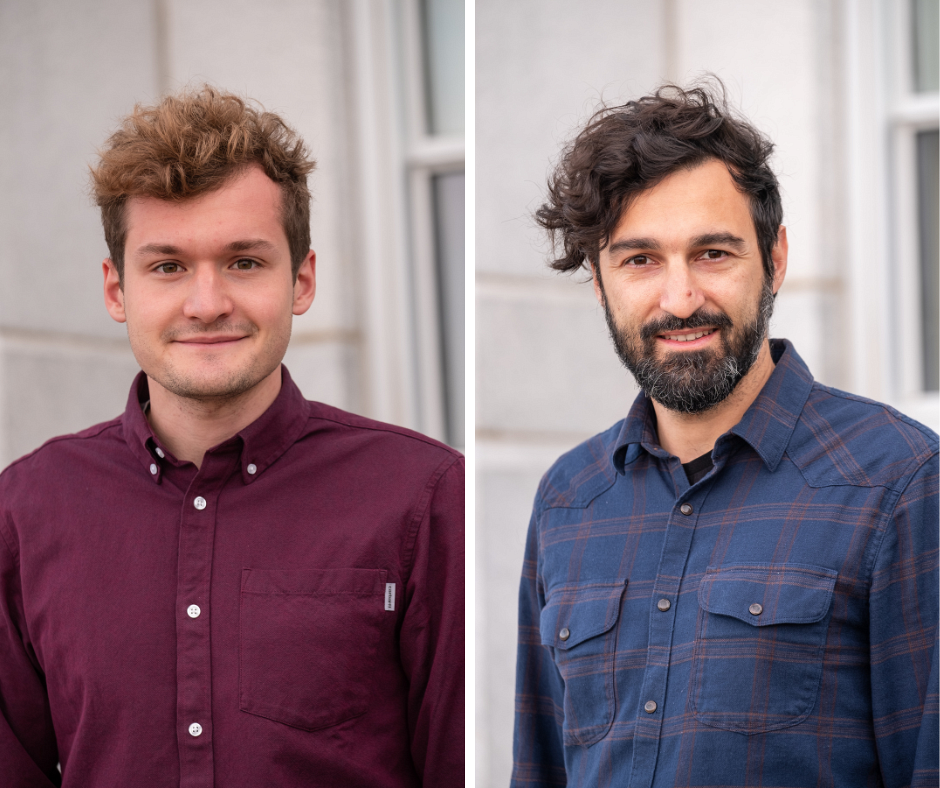
Nothing beats open-source software for generating a dynamic programming community, as it enables anyone to take existing software and adapt it as they see fit. Despite the current race to develop quantum computers, the field of quantum programming gives room for this approach.
This sharing spirit can even be rewarded with a financial boost, as in the case of Aleksandr Berezutskii, a PhD student since September 2020 in the group of Stefanos Kourtis, professor in the Department of Physics and member of the Quantum Institute. In July 2023, Aleksandr received a microgrant of 4,000 USD from the Unitary Fund organization for the development of mdopt, a software program for error correction during decoding, which was created as part of his PhD project. The Unitary Fund is a non-profit organization that supports each year a number of quantum technology projects that can benefit as many people as possible. These include open-source software, educational materials and workshops.
Aleksandr is very quick-witted and has a lot of initiative! It was his idea to apply for this grant, given that the organization’s vision and interests are aligned with ours. We wanted the software to not only be open access, but open-source.
Professor Kourtis
The quantum programming field is moving forward in a very communal way and I love this community, there are a lot of smart people to work with. The industry is very effervescent at the moment, there’s a lot of effort, a lot of research… That too is very stimulating! And developing open-source software is important if you want people to use it.
Aleksandr
Kallie Ferguson, Ecosystem Director at Unitary Fund, agrees:
Open-source projects benefit everyone, and that’s why it’s so popular in classical programming. Quantum computing is such a nascent field, so one company will not have all the answers.
Compensating for Imperfect Chips
To understand what mdopt does, you first need to know that quantum computers, while promising, are not powerful enough yet to solve real-world challenges such as optimization problems or molecule simulations. This is partly because the quantum states prepared with the chip are imperfect and fragile, so the information is lost in noise, i.e., disturbances that make the system harder to read.
If we’re worried that the information processed will be too distorted by errors, we can opt for the strategy of working with several copies of the same information. The operations are then repeated several times, and we assume that the predominantly received response is the correct one. The more copies of the information we send, the more confidence we can have in the predominant response.
However, this strategy is not ideal. To reduce the need to repeat the same operations over and over again, quantum information research can investigate both hardware improvements and the development of software tools to reduce noise. Aleksandr’s project falls into the latter category.
More specifically, his doctorate focuses on quantum tensor networks, i.e., mathematical tools for solving problems with quantum circuits. To carry out this highly specialized work, Aleksandr had to produce his own programming tools, including the mdopt software, much like an artist who has to prepare specific color mixtures before he can paint a canvas. The paint mixes can then be reused in other projects or by other people, and so can mdopt!
Aleksandr also points out that his software is “hardware agnostic”, meaning that it will be able to help correct errors during decoding with different types of quantum computers. This is quite an advantage, considering that we still don’t know which kind of hardware will be found in the first quantum computer that will be robust enough to be applied to real-life problems.
In the meantime, mdopt is being tested with simulations of quantum algorithms, and the results demonstrating the software’s effectiveness should be published in a scientific journal within the next year. Aleksandr is pleased to report that several external users have already made use of the software, which is available on GitHub (https://github.com/quicophy/mdopt), and that it has even already received several stars, the equivalent of “like” mentions on this platform. “It gives me great satisfaction to see that my software is already appreciated!”
It’s nice to see good open-source material being valued and used by the community. Aleksandr’s software was an easy case for the microgrant evaluation committee. In its comments, the committee indicated that the impact of mdopt would be positive, and that an error correction tool was something that was greatly needed.
Kallie Ferguson
Incidentally, Kallie Ferguson invites the quantum programming community to express their views on the next most pressing challenges to be solved by completing the Unitary Fund’s annual survey through the following link: https://www.surveymonkey.com/r/qosssurvey24. Who knows what next UdeS’ initiative will be inspired by these needs!