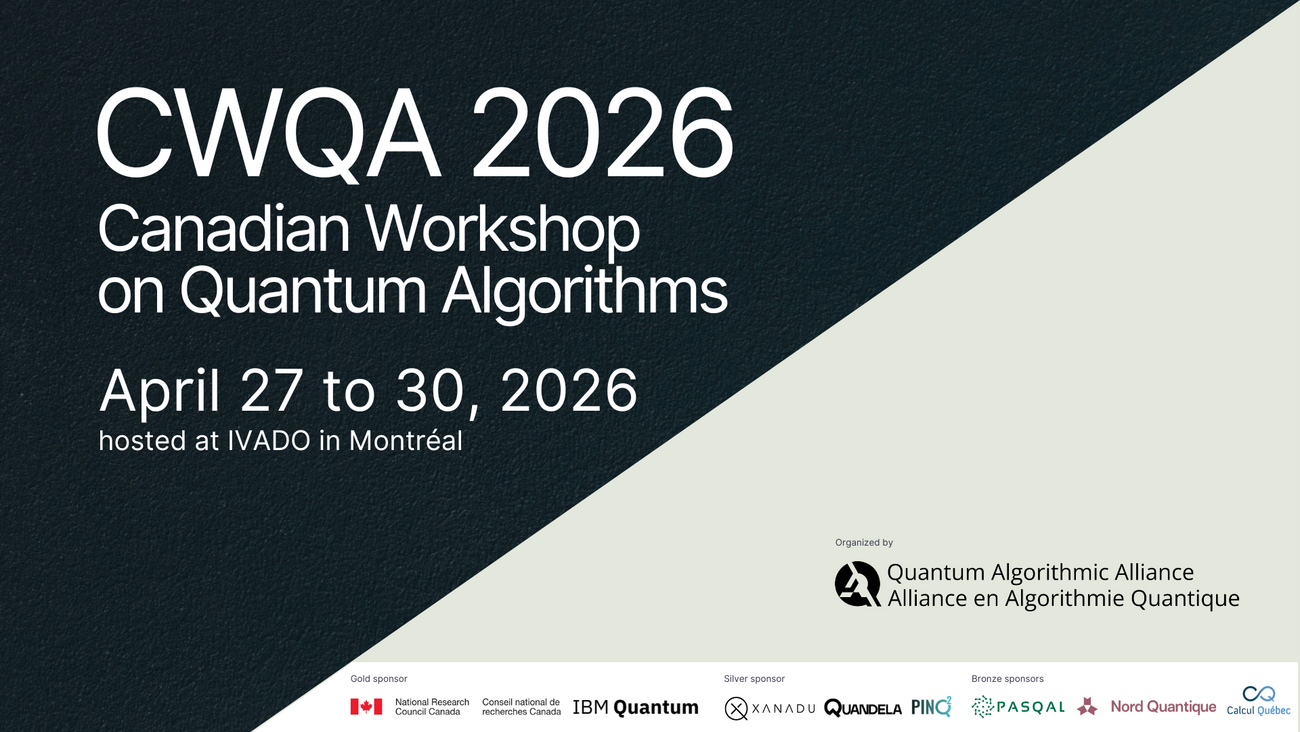
CWQA 2026
About the workshop
The Canadian Workshop on Quantum Algorithms brings together researchers and students from across Canada—alongside industry partners—to advance quantum algorithms from foundational theory to practical, high-impact applications.
Designed as a highly interactive forum, the workshop will enable participants to share ideas, develop new concepts, and initiate collaborations across institutions and sectors. As places are limited, we encourage you to register early to secure your spot.
A key goal is to collectively shape a Canadian roadmap for developing quantum algorithms that demonstrate quantum advantage, aligned with Canada’s research strengths and industrial ecosystem.
Objectives
- Foster a national community in quantum algorithms
- Advance the development of quantum algorithms research
- Support the next generation of researchers and trainees
- Define a collaborative Canadian roadmap toward quantum advantage
Program highlights
- Keynote presentations from leading Canadian and international experts
- Invited talks by cutting-edge researchers and emerging scholars
- Student poster session to showcase work, receive expert feedback, and connect with peers
- Hands-on tutorials supporting student training across quantum algorithm design, analysis, and implementation
Who should attend
- Faculty, postdocs, and research staff working in quantum algorithms and related areas
- Graduate and undergraduate students exploring quantum algorithm research
- Researchers from quantum hardware providers and industry R&D teams
- Anyone interested in shaping Canada’s quantum algorithms roadmap and collaborations
Location
CWQA 2026 will be held at IVADO : 950 Av. Beaumont, Suite #201, Montréal, QC H3N 1V5
Program and session details
Tutorials Day (Aligned with Days 2–4; not a QC intro)
- 08:30 Welcome coffee
- 09:00 Tutorial 1 - Building Useful Quantum Applications: Assembling Algorithmic Primitives for Chemical Dynamics, Ignacio Loaiza, Xanadu
- Abstract: Connecting quantum computing algorithms to real-world applications is crucial, with true utility emerging in domains that are both classically intractable and highly valuable to industry and science. Within this context, the dynamical simulation of chemical systems represents a particularly promising frontier; it goes beyond traditional ground-state energy estimation to address complex, time-dependent processes that are notoriously hard to model classically. Specifically, simulating pre-Born-Oppenheimer dynamics stands out as a highly relevant approach for areas like catalysis and materials discovery. It provides a black-box method that treats electrons and nuclei on an equal footing, capturing all quantum effects simultaneously. This talk provides an overview of a recently developed algorithm that integrates several central building blocks of quantum computing: Quantum Signal Processing (QSP), Linear Combination of Unitaries (LCUs), block-encoding techniques, and quantum arithmetic. Finally, we will outline the workflow for compiling these primitives to extract logical resource estimates using PennyLane, showcasing the algorithmic requirements for practical pre-Born-Oppenheimer chemistry simulations.
- 10:30 Break
- 11:00 Tutorial 2 - Nathan Wiebe, University of Toronto
- 12:30 Lunch
- 13:30 Tutorial 3 - Beyond VQE: Sampled-based quantum diagonalization, Ibrahim Shehzad, IBM
- Abstract: In this tutorial, we will cover the fundamentals of sampled-based quantum diagonalization, an algorithm which circumvents the common pitfalls of variational quantum algorithms and has recently produced several promising results for quantum chemistry and hamiltonian evolution problems, on pre fault-tolerant quantum hardware, at the utility scale. We will also go over a python notebook that shows how this technique is implemented in practice in Qiskit.
- 15:00 Break
- 15:30 Tutorial 4 - Core Concepts in Quantum Error Correction and Fault-Tolerance, Olivier Landon-Cardinal, ÉTS
- Abstract: In this tutorial, I will try to convey intuition on core concepts of QEC and FT by working out specific examples (and stating the general results). We will focus on the 7-qubit Steane code, the simplest CSS code. The tutorial will be on the board. Questions are welcome!
- 17:00 Happy hour
AM — EFTQC, FTQC & Verification of quantum advantage
(Links to QEC & quantum architecture; quantum advantage; restricted computation with advantage)
- 08:50 Welcome
- Objectives
- Talks as discussion starters
- Workshops as main objective
- 09:10 Keynote 1 - Peaked quantum advantage using error correction, Bill Fefferman, University of Chicago
- Abstract: A key issue of current quantum advantage experiments is that their classical verification requires a full simulation of the ideal computation. This limits the regime in which the experiments can be verified to precisely the regime in which they are also simulatable. An important outstanding question is therefore to find quantum advantage schemes that are also classically verifiable. We make progress on this question by designing a new quantum advantage proposal -- Hidden Code Sampling -- whose output distribution is conditionally peaked. These peaks enable verification in far less time than it takes for full simulation. At the same time, we show that exactly sampling from the output distribution is classically hard unless the polynomial hierarchy collapses. Our scheme is based on ideas from quantum error correction but can be implemented in the near-term. Our proposal may thus give rise to a next generation of quantum advantage experiments en route to full quantum fault tolerance.
- 10:00 Talk 1 - Paving the way to FTQC at Quandela: Quantum Computing based on Quantum Dots and Photons, Valérian Giesz, Quandela
- Abstract: In my presentation, I will explore Quandela’s strategic pathway to achieving fault-tolerant quantum computing through its proprietary photonic platform. The talk will trace the evolution from today’s NISQ-era processors to scalable, error-corrected architectures, highlighting the unique advantages of deterministic single-photon sources, room-temperature operation, and seamless optical networking. Attendees will gain insight into Quandela’s full-stack approach — from cutting-edge hardware and error mitigation techniques to software, cloud services, and ecosystem partnerships — and see how these elements converge in a clear roadmap toward commercially viable, large-scale, fault-tolerant quantum systems.
- 10:30 Break
- 11:00 Breakout discussions (3 parallel)
- Canadian roadmap (main workshop theme)
- Keynote 1 debrief
- Talk 1 debrief
- 12:00 Lunch
PM — Quantum learning
(State tomography, classical shadows, QML, ML for quantum, etc.)
- 13:30 Talk 2 - Optimizing quantum control with reinforcement learning, Stefanie Czischek, University of Ottawa
- Abstract: Implementing quantum algorithms on current quantum hardware requires precise and robust control of experimental systems. However, quantum optimal control remains challenging due to decoherence, external noise, and device imperfections. We investigate the use of reinforcement learning (RL) to discover optimal control strategies that adapt to the behaviour of individual quantum devices. In this talk, I will present a benchmark of our RL approach in quantum sensing tasks where Hamiltonian parameters are not precisely known. Specifically, we consider a spin-based magnetometer, in which the magnitude of an unknown magnetic field is estimated via projective measurements. The estimation precision can be enhanced by applying sequences of transverse-field pulses with varying strengths. I will show how an RL algorithm can learn pulse sequences that optimize measurement precision generalize beyond training conditions. These results demonstrate the potential of using RL for quantum optimal control in a range of applications, including quantum sensing and quantum algorithm implementation.
- 14:00 Talk 3 - Recent Progress in Quantum State Learning: Tomography, Classical Shadows, and Beyond, Ningping Cao, NRC
- Abstract: Quantum state learning includes tasks ranging from full tomography to the estimation of selected observables and other state properties under structural assumptions. In this talk, I will review several recent developments in this area. I will start with quantum state tomography as a basic framework, and then discuss shadow tomography and classical shadows as influential tools for predicting many observables efficiently. I will next highlight developments beyond the original classical-shadow framework, especially questions of optimality. I will also touch on machine-learning-based methods for quantum state characterization in noisy or structured regimes. The goal of the talk is to give a concise picture of what can be learned efficiently about quantum states, and under which assumptions.
- 14:30 Break
- 15:00
- Breakout discussions
- Parallel tutorial 1 - Fundamental of quantum chemistry and mapping to quantum computers, Matthieu Fortin-Deschênes, PINQ2
- Abstract: This tutorial provides an overview of the formalism of quantum chemistry, its methods, their dimensionality and how they can benefit from quantum computing. It covers the many-body electronic structure problem, the single-particle picture and Hartree–Fock model, second quantization and post–Hartree–Fock methods, as well as the mapping of the second-quantized Hamiltonian to the qubit representation. The tutorial aims at providing a better intuition about the fundamental underpinnings of quantum chemistry to the quantum computing practitioner by briefly covering key topics.
- 16:00 Lightning poster pitches
- 16:30 Poster session
- 18:00 End of Day 2
AM — Quantum simulation
(Product formulas, QSVT, analog, digital-analog, etc.)
- 09:00 Welcome
- 09:10 Keynote 2 - Efficient Quantum Simulation for Nonlinear Stochastic Differential Equations, Nathan Wiebe, University of Toronto
- Abstract: Nonlinear stochastic differential equations (NSDEs) are a pillar of mathematical modeling for scientific and engineering applications. Accurate and efficient simulation of large-scale NSDEs is prohibitive on classical computers due to the large number of degrees of freedom, and it is challenging on quantum computers due to the linear and unitary nature of quantum mechanics. We develop a quantum algorithm to tackle nonlinear differential equations driven by the Ornstein-Uhlenbeck (OU) stochastic process. The query complexity of our algorithm scales logarithmically with the error tolerance and nearly quadratically with the simulation time. Our algorithmic framework comprises probabilistic Carleman linearization (PCL) to tackle nonlinearity coupled with stochasticity, and stochastic linear combination of Hamiltonian simulations (SLCHS) to simulate stochastic non-unitary dynamics. We obtain probabilistic exponential convergence for the Carleman linearization of Liu et al., provided the NSDE is stable and reaches a steady state. We extend deterministic LCHS to stochastic linear differential equations, retaining near-optimal parameter scaling from An et al. [2] except for the nearly quadratic time scaling. This is achieved by using Monte Carlo integration for time discretization of both the stochastic inhomogeneous term in LCHS and the truncated Dyson series for each Hamiltonian simulation.
- 10:00 Talk 4 - Practical quantum algorithms for quantum simulation, Juan Miguel Arrazola, Xanadu
- Abstract: We give an overview of Xanadu's progress in developing low-cost quantum algorithms for quantum simulation. This includes a description of algorithmic building blocks, such as initial state preparation and Hamiltonian simulation using Trotter product formulas, as well as an overview of valuable applications such as Lithium-excess batteries, singlet-fission solar cells, and photoresists for EUV lithography.
- 10:30 Break
- 11:00 Breakout discussions (3 parallel)
- Canadian roadmap (main workshop theme)
- Keynote 2 debrief
- Talk 4 debrief
- 12:00 Lunch
PM — QC for scientific computation
(PDEs, linear algebra, optimization, chemistry, etc.)
- 14:00 Keynote 3 - Quantum advantage challenge problems, Peter Love, Tufts University
- Abstract: In this talk I will discuss challenge problems in quantum chemistry, high energy and nuclear physics whose solution on quantum computers could demonstrate quantum advantage. I will also discuss various types of claims of quantum advantage, mechanisms to encourage productive adversarial competition around quantum advantage, focusing on the question: How will we establish scientific consensus around claims of quantum advantage?
- 15:00 Break
- 15:30
- Workshop: Quantum advantage roadmap
- Parallel tutorial 2 - Quantum Methods of Linear Algebra, Thomas Baker, University of Victoria
- Abstract: One of the major successes of the past century has been the use of classical electronic computers to compute operations involving linear algebra. Operations such as matrix multiplication, matrix-vector multiplication, and eigenvalue decompositions are not only carefully programmed on the classical computer, but they are also designed with hardware sizes and cache size requirements in mind. Linear algebra methods are nearly ubiquitous in many applications spanning many areas, making them some of the most important and fundamental methods in computer science. Many libraries have been crafted over decades to ensure that answers can be obtained as quickly and accurately as possible on the classical computer. Emerging methods of quantum solutions for linear algebra problems have been proposed to be accomplished in exponentially faster time, often with caveats. Understanding how the quantum methods function, where their limitations are, and where classical methods can be used with a quantum subroutine are important emerging areas considering the wide-application of quantum methods. In this tutorial, classical methods of computation are reviewed and where applications of linear algebra methods in quantum systems becomes necessary. Then, the basics of some quantum algorithms and their limitations is discussed. Only a knowledge of quantum mechanics is assumed.
- 17:00 End of Day 3
- 18:30 Networking Dinner (registration required)
AM — Practically useful quantum computing
- 09:00 Welcome
- 09:10 Keynote 4 - Towards practically useful quantum algorithms, Sergey Bravyi, IBM
- Abstract: Simulation of quantum many-body systems relevant to chemistry or material science is one of the most plausible applications of fault-tolerant quantum computers. However, early fault-tolerant machines with a few hundred logical qubits and a limited shot budget are unlikely to replace classical high-performance computing end-to-end. Instead, they may become useful as coprocessors for accelerating certain steps in classical simulation workflows. In this talk I will focus on quantum impurity models as a case study. These models arise naturally in embedding methods such as dynamical mean-field theory (DMFT), where a complicated many-electron problem is reduced to a small interacting fragment coupled to an effective bath. Classically, one of the most expensive steps in the DMFT workflow is the computation of the impurity Green’s function. I will argue that this task is a natural target for fault-tolerant quantum computers equipped with block-encoding primitives for the impurity Hamiltonian. I will also review known results on the complexity of ground state problems for quantum impurity models and discuss possible verification methods.
- 10:00 Break
- 10:30 Workshop: Building a Canadian roadmap — How to start projects now?
- 12:00 Lunch
PM — Student presentations & wrap-up
- 13:30 Student Talk 1 - Mid-circuit measurement as an algorithmic primitive, Antoine Lemelin, École de Technologie Supérieure
- 13:45 Student Talk 2 - Quantum-Efficient Reinforcement Learning Solutions for Last-Mile On-Demand Delivery, Farzan Moosavi, Toronto Metropolitan University
- 14:00 Student Talk 3 - TERRA: Tensor-network Error-mitigated Robust Randomized Algorithm, Julien-Pierre Houle, Université de Sherbrooke
- 14:15 Student Talk 4 - Development of quantum kernel learning models for data-driven coupled-cluster scheme, Ashwin Sivakumar, University of Calgary
- 14:30 Break
- 15:00 Unconference session
- 17:00 End of Day 4
Student poster session
Students are invited to present their work during a dedicated poster session. This is an opportunity to:
- Share ongoing research in a supportive environment
- Receive feedback from experts
- Meet potential collaborators and mentors
Poster submission deadline: March 13th 2026
Registration
*** CWQA 2026 Registration is now closed.
Please note you should receive an official confirmation email within two working days that will confirm your registration to CWQA 2026.
Registration deadline: April 6th 2026
Planning committee
- Ghislain Lefebvre, IQ — QAA President of the Operations Committee
- Josée Savard, IVADO — QAA Operations Committee
- Valérie Boissonneault, ETS — QAA Operations Committee
- Cunlu Zhou, IQ
- Simon Verret, IQ, AlgoLab
- Hlér Kristjansson, UdeM
- Olivier Landon-Cardinal, ETS
- Adam Bene Watts, UCalgary
- Thomas Baker, UVic
- Victor Drouin-Touchette, IQ
- Christophe Pere, Nord Quantique
- Camille Brun-Jolicoeur, IBM
- Mohammad Kashfi, PINQ2
- Juliette Geoffrion, Calcul Québec
Contact
Questions about registration, posters, or logistics?
Email: tom.mallah@usherbrooke.ca
Officlal sponsors
We would like to thank our official sponsors for supporting CWQA 2026
About the Quantum Algorithmic Alliance

The Quantum Algorithmic Alliance (QAA) is a partnership between Université de Sherbrooke (UdeS), ÉTS, and Université de Montréal (UdeM) dedicated to advancing collaborative research in quantum algorithms and training highly qualified talent. It unites these institutions and other like-minded organizations to develop innovative quantum computing solutions, while strengthening members’ research capacity and fostering collaboration across academia, industry, and government.