2026 - Biodiversity Modelling Summer School
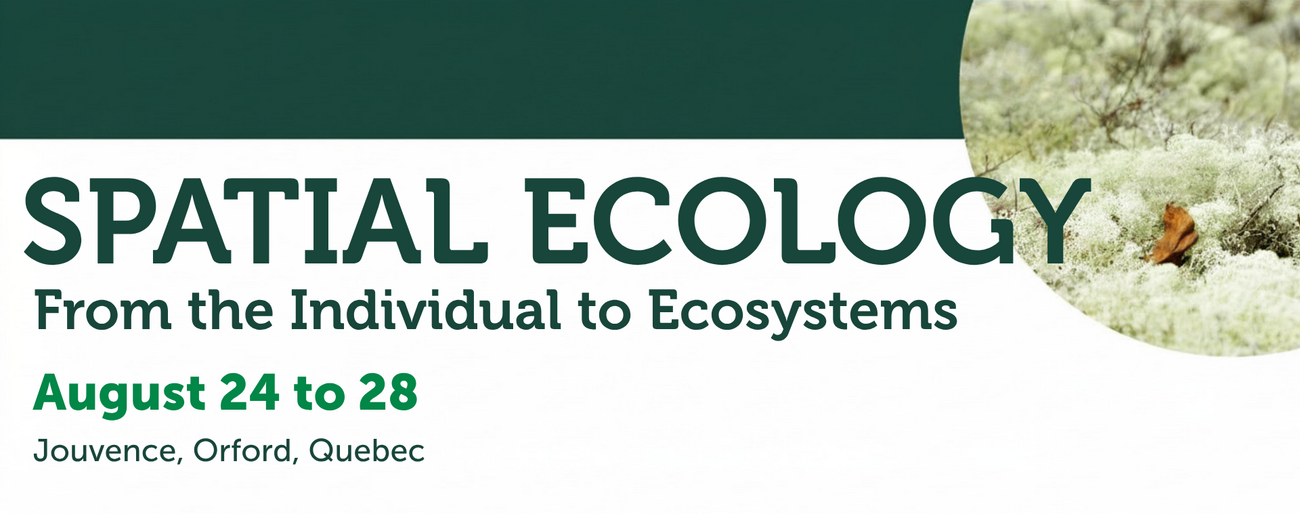
Presentation
Biodiversity is remarkably complex across different spatial scales. Understanding the spatial processes responsible for this variability is one of the most dynamic, multifaceted and challenging fields in ecology. Populations, communities, and ecosystems are connected in space through the movement of individuals and fluxes of material and energy. Thus, understanding the distribution of biodiversity and predicting its response to global changes cannot be done without considering the proximity and exchanges between ecosystems. Spatial ecology addresses a wide range of topics, including coexistence, use of space, trophic network organization, stability, assessment of biodiversity, and optimization of protected areas.
The overall objective of the summer school is to explore how spatial processes influence community organization, from movement of individuals to ecosystem functioning. We will review the basic theories and present various mathematical, numerical, and statistical techniques used in spatial ecology.
Instruction will combine lectures, guided exercises, and group projects spread throughout the week-long training. Experts in various fields will participate in the training, offering seminars on cutting-edge topics and techniques.
Topics
- Ecology of metapopulations, communities, and ecosystems
- Island biogeography
- Ecological interaction networks
- Hierarchical community models
- Beta-diversity analyses
- Individual movement and habitat selection
Instructors
- Dominique Gravel, professor at the Université de Sherbrooke
With the participation of:
- Pr. Guillaume Blanchet, Université de Sherbrooke
- Pr. Pedro Peres-Neto, Concordia University
- Pr. Éric Harvey, Université du Québec à Trois-Rivières
- Pr. April Martinig, Université de Sherbrooke
- Other guest speakers
Prerequisites
The summer school is intended for graduate students and professionals in the field of biodiversity science as well as in related disciplines such as forestry, oceanography, limnology, and geomatics.
Information about venue
- Date: August 24 to 28, 2026
- Location: Jouvence Resort in Orford, Quebec
- Registration fee: 700$ (shared room) 850$ (private room)
Price includes course registration, accommodation and meals
CSBQ Intensive Course
The CSBQ Intensive Course Award covers 50% of summer school tuition fees for its members.
Registration
Those interested in participating must complete the form by June 15, 2026.
Fill out the registration form
This step is a preliminary registration. All applications will be reviewed to ensure that the prerequisites are met. If the number of registrations is too high, applicants will be selected.
Official registration (admission to the University and payment of registration fees) will take place during the week of June 22, 2026.
Official 3-credit course (at the MSc or PhD level) from the Faculty of Science of the Université de Sherbrooke
Contact us
Summer School in Biodiversity Modelling
Kim Gauthier Schampaert
Coordonnatrice au Laboratoire d'écologie intégrative (IELab)
Département de biologie
Université de Sherbrooke
Phone: (819) 821-8000 # 62591
Email: Kim.Gauthier.S@USherbrooke.ca
Département de biologie
Université de Sherbrooke
Email: etud.superieures.biologie@USherbrooke.ca
This summer school is supported by Université de Sherbrooke, the Quebec Center for Biodiversity Science (QCBS) and BIOS2, a training program in computational biodiversity science.