By outsmarting time, a team improves access to an innovative treatment against metastatic prostate cancer
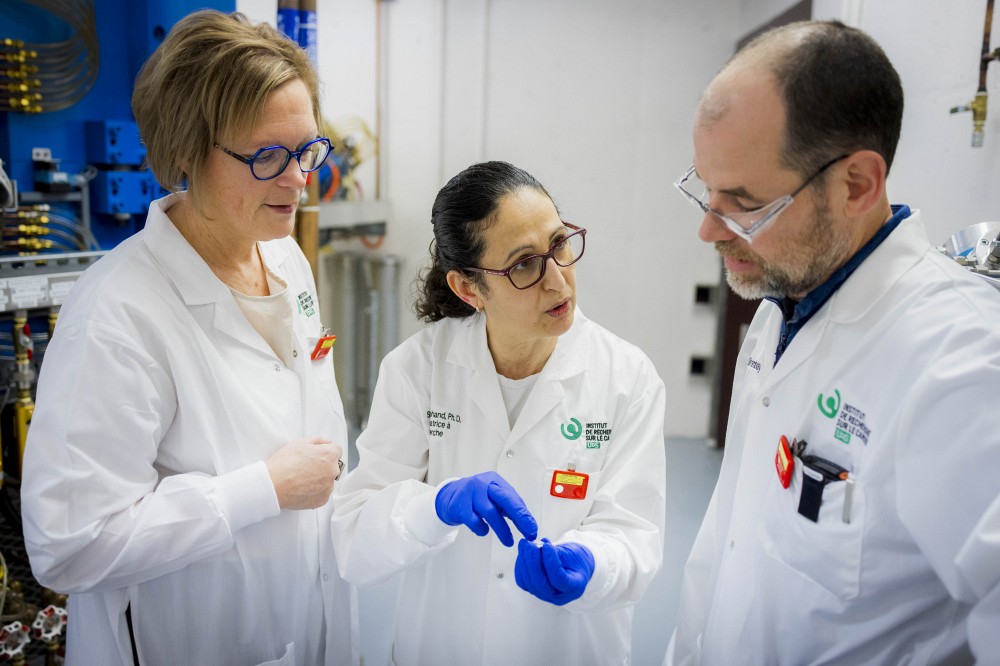
Photo : Mathieu Lanthier - UdeS
In 2018, a major study assembled 40 researchers from various fields throughout the province of Quebec, with an audacious mission: improve the imaging and the treatment of treatment-resistant metastatic prostate cancer. Under the direction of Brigitte Guérin, Professor and Researcher at Université de Sherbrooke Cancer Research Institute (IRCUS), this research project has just concluded, exceeding not only expectations but also giving hope to hundreds of patients.
The technical challenge: the production of gallium-68 (68Ga) tracers at the heart of a project covering the whole province
The first step of the initiative was to develop radioactive molecules (68Ga tracers) capable to accurately detect and characterize metastases. These 68Ga tracers were to be produced in Sherbrooke and shipped to four major research centres in Quebec City and Montreal, before being administered to patients: a near impossible logistic challenge, considering that half of 68Ga has disintegrated after 68 minutes. Through Prof. Guérin’s leadership, the team managed to overcome this major obstacle by developing the technologies that allowed the large-scale production of 68Ga with a cyclotron, as well as prolonging to up to 5 hours the time during which the radioactive tracers can be used. Consequently, the 68Ga tracers could be distributed and tested on patients throughout the province.
Moreover, Prof. Guérin chose to develop an innovative 68Ga labeling process that will enable the transformation of each 68Ga tracer into an injectable precision radiotherapy treatment, a new type of treatment that is rapidly emerging.
Photo : Mathieu Lanthier - UdeS
A Major Clinical Breakthrough
In the study, 98 patients with a metastatic prostate cancer resistant to standard treatment, used to slow down the disease, were imaged using an innovative strategy with three radioactive tracers: two 68Ga tracers (68Ga-PSMA-617 and 68Ga-DOTATATE) and one fluorine-18 tracer (18F-FDG). These tracers act as precise guides, making possible a detailed mapping of all the patient’s metastases, along with an analysis of their characteristics, without the need for multiple biopsies.
When cancer returns following a first treatment, or progresses under a treatment, the cancerous cells will often mutate and propagate to form heterogenous metastases, rendering the treatments ineffective. Through imaging with these tracers, we can not only localize accurately the metastases but also identify the most promising therapeutic options.
Brigitte Guérin, Professor and Researcher at IRCUS and the Faculty of Medicine and Health Sciences
The Triple-Tracer strategy proved to be a winner to help the team better understand the complexity of the disease of each patient, and to enable oncology and nuclear medicine specialists to tailor treatment to the unique characteristics of cancer cells. The study showed that over 83% of patients have metastases with heterogenous characteristics and that this heterogeneity is associated with a shorter survival.
Most surprising for the team was the fact that more than 50% of patients were eligible for receiving a new injectable precision radiotherapy treatment, 177Lu-PSMA. And so, even before this innovative treatment was available to patients in Quebec, the team enabled more than 30% (30 out of 98) of their study's participants to benefit from it.
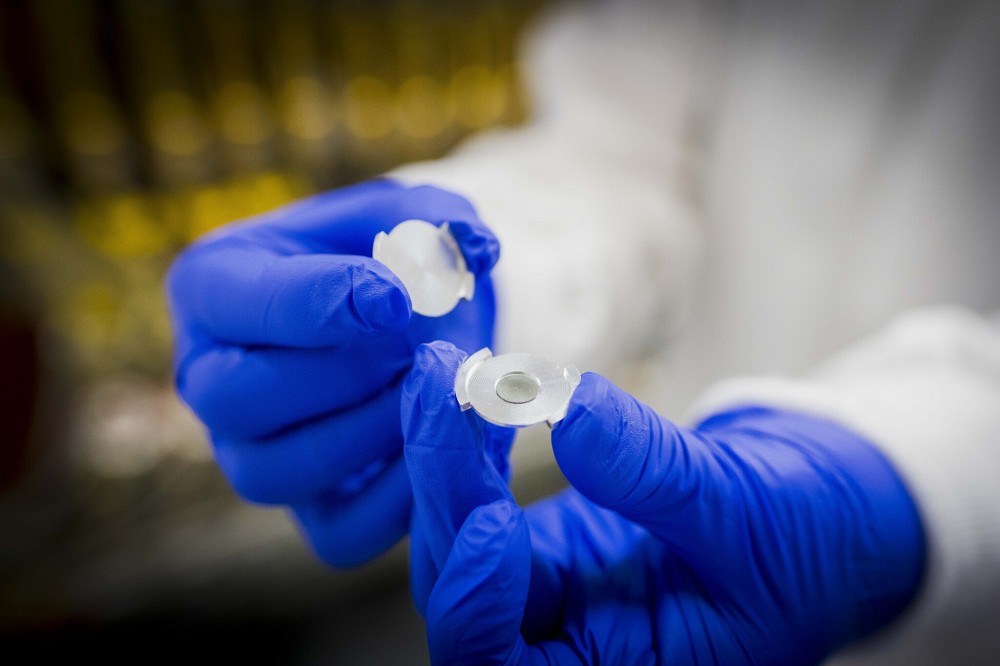
Photo : Mathieu Lanthier - UdeS
Outsmarting Time to Shorten Treatment Delays
Led by Prof. Guérin, internationally recognized for her expertise, the team proved that it was possible to overcome the time constraints imposed by the fast disintegration of 68Ga, to offer a better chance of survival to a greater number of patients. Thanks to these breakthroughs, each new production of 68Ga not only outsmarts time but also shortens treatment delays for many Quebecers.
To this day, the research team of Prof. Guérin is the only one in the province of Quebec that produces massively and routinely 68Ga with a cyclotron, using their patented processes on solid targets. Two weekly productions generate a large quantity of 68Ga tracers, which are currently exploited in clinical practice at Sherbrooke for more than 1,000 patients each year.
An Exemplary Leadership and Collaboration
The success of this project relies on the extended collaboration between Prof. Guérin’s team and four oncology clinics composed of oncologists and nuclear medicine specialists. The Université de Sherbrooke’s leadership, supported by young researchers, research professionals and students, allowed for the transformation of this ambitious idea into a clinical reality.
The results obtained pave the way for new clinical studies, in the hope of developing even more accurate and effective therapies. "We have taken a decisive step forward, but it is only a beginning. These data let us envision a future where cancer will be treated with unparalleled precision and personalization.”, concludes Brigitte Guérin.
This project was carried out thanks to an outstanding collaboration with the Centre de recherche du CHUS Platforms, namely: the Sherbrooke Molecular Imaging Center for the production and distribution of radiotracers, the Clinical and Epidemiological Research Unit for the coordination of the clinical study, and the CRED IT Platform for the database.
This research was made possible thanks to major financial support from Oncopole, which received funding from Merck Canada Inc. and the Fonds de recherche du Québec – Santé, as well as the Cancer Research Society (learn more). A major financial contribution from the CHUS Foundation enabled the purchase of equipment for the production of 68Ga tracers.
About Brigitte Guérin
- Holder of the Chair Jeanne et Jean-Louis Lévesque de radiobiologie
- Professor and Researcher at the Department of Medical Imaging and Radiation Sciences of the Faculty of Medicine and Health Sciences
- Professor and Researcher at the Université de Sherbrooke Cancer Research Institute (IRCUS)
- Professor and Researcher at the Pharmacology Institute of Sherbrooke (IPS)
- Director of the Université de Sherbrooke Centre of Excellence in Medical Imaging (CIMUS)
- Co-Director of the Medical Imaging Axis of the Centre de recherche du CHUS (CRCHUS)