Strategic Partnership | IRC Innovations for a Sustainable Planet
UdeS and the CNRS Join Forces for a Sustainable Planet
Ranked first in the world for sustainable development and tenth in Canada for research, the UdeS is becoming a key partner in a new international research center created by the French National Center for Scientific Research (CNRS) to conduct research—particularly in quantum sciences and nanotechnologies—with a focus on responsible innovation.
The launch of the international research center (IRC) “Innovation for a Sustainable Planet” took place in Montreal on April 12, during the 21st Alternating Meeting of the First Ministers of Quebec and France.
Ranked sixth in the world and first in Canada, the IRC will draw on the University of Sherbrooke’s (UdeS) unique research ecosystem, which maintains close ties with the industrial sector thanks to a culture of collaborative innovation that facilitates “business-university” partnerships. It is worth noting that the University of Sherbrooke is also a partner in the first two innovation zones created by the Government of Quebec in 2022, in the fields of quantum sciences and digital technologies.
Collaborations between the UdeS and the CNRS have increased since 2012, and the creation of this IRC reflects a deepening of the partnership between the two organizations:
This IRC with the University of Sherbrooke is the natural next step following several years of fruitful cooperation between our two institutions. It builds on our respective research and innovation capabilities. It also reflects the acceleration and intensification of cooperation between the CNRS and Canada since the opening, in early 2022, of a CNRS office in Ottawa. Canada—the fourth-largest country outside the European Union in terms of the volume of co-publications, with more than 2,400 scientific articles each year—is indeed a key global partner for the CNRS, and we are very pleased with this new channel for collaboration with the UdeS.
Antoine Petit, President and CEO of the CNRS
The CNRS has been developing a strong partnership with the UdeS for over fifteen years in the fields of nanoscience and nanotechnology—including, notably, a joint laboratory with STMicroelectronics—as well as in quantum sciences and, more recently, in other fields such as acoustics and bioengineering.
Jan Matas, Director of the CNRS Canadian Office
UdeS is proud to be at the heart of this new sharing of expertise and infrastructure with the CNRS, which will facilitate the application of the scientific and technological advances that will be made.
The IRC Innovation for a Sustainable Planet will stimulate new collaborative projects combining basic and applied research, which will foster the emergence of new technologies and social innovations, their transfer to society, and the training of the next generation of specialists.
Professor Pierre Cossette, Rector of UdeS
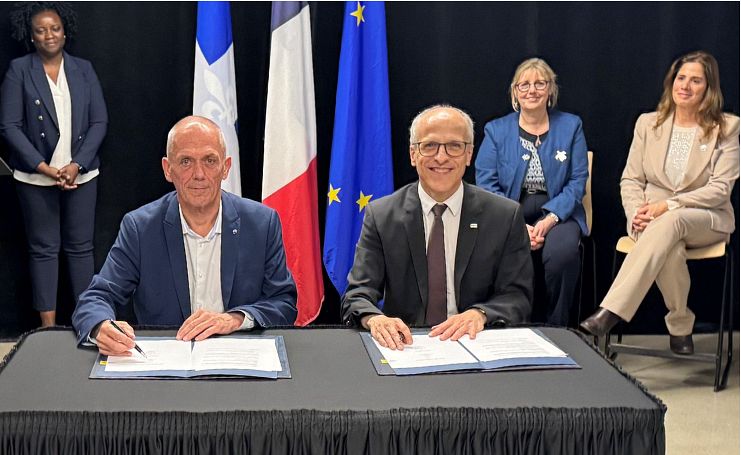
CNRS President and CEO Antoine Petit and the Rector of the University of Sherbrooke, Prof. Pierre Cossette, officially signed the agreement establishing the “Innovation for a Sustainable Planet” international research center.
Photo : Courtesy
UdeS is already home to two international research laboratories resulting from a partnership with the CNRS: the Nanotechnologies and Nanosystems Laboratory (LN2), launched in 2012, and the Quantum Frontiers Laboratory, created in 2022.
In addition to the work carried out in these two laboratories, the IRC will conduct research on eco-materials, systems, and processes; green chemistry; and biodiversity, complemented by a cross-cutting focus on responsible innovation.
This France-Quebec partnership will also benefit research students, as the IRC “will increase the international mobility of research staff, from doctoral students to researchers,” according to Sébastien Tanzili, deputy scientific director at CNRS Physics and co-director.
Lionel Buchaillot, director of CNRS Engineering, sees this new center as a precursor to a future network of IRCs, which could draw on the LN2, “a key player in the fields of nanotechnology and its application to environmental issues.” A strong link with the IRC France–Arizona Institute for Global Grand Challenges has already been established in the field of photovoltaics, and connections may also be forged withthe IRC in São Paulo, again on issues related to major environmental challenges.”
A symposium is scheduled for June 4 and 5, 2024, at the University of Sherbrooke to define the research areas and determine the subjects of study.
An IRC is a new institutional framework created by the CNRS that aims to establish an ambitious strategic dialogue between the CNRS and its university partner. The IRC serves as a framework for defining their common interests and the collaborations that will enable them to address those interests, and takes the form of international research laboratories, research projects, thematic networks, or other initiatives.