Tiny, Yet Crucial for the Future of Oncology
Photo : Mathieu Lanthier - UdeS
What if major breakthroughs against cancer were hidden where no one had ever looked? This is the hope raised by a study published in the prestigious journal Nature by the international TransCODE consortium in which Professor and Researcher Marie Brunet from the Université de Sherbrooke Cancer Research Institute (IRCUS) and the FMSS played a central role.
The published findings pave the way for faster identification of new therapeutic targets, a better understanding of mechanisms of resistance to treatments, and the development of more precise diagnostic biomarkers. The study shows that cells, including cancer cells, produce thousands of extremely small proteins that long went unnoticed but are in fact present. This discovery is significant, as even a tiny protein can play a crucial role. Insulin is a compelling example: despite its small size, it is essential to life.
New Foundations for the Study of Disease
For decades, biomedical research has relied on a well‑defined list of proteins to understand how cells become diseased and how they can be treated. The work of the TransCODE consortium now expands this list by revealing the existence of a vast set of previously overlooked microproteins.
Naming the Invisible: Peptideins
For a long time, these small proteins existed in a scientific grey area: they were sometimes observed, but without a clear way to classify them or understand their role. The term peptidein, introduced by the TransCODE consortium and now recognized by GENCODE, the global reference database for human genes and proteins, clearly confirms their existence—even though their biological function remains to be discovered.
This recognition brings them out of the shadows and concretely accelerates cancer research by making previously inaccessible information usable by researchers worldwide. While it is not yet known which peptideins may prove as important for cancer as insulin has been for diabetes, this new framework opens the door to major discoveries.
Marie Brunet, holder of the CRMUS Chair in Artificial Intelligence and Multi‑omics Applied to Pediatric Pathologies.
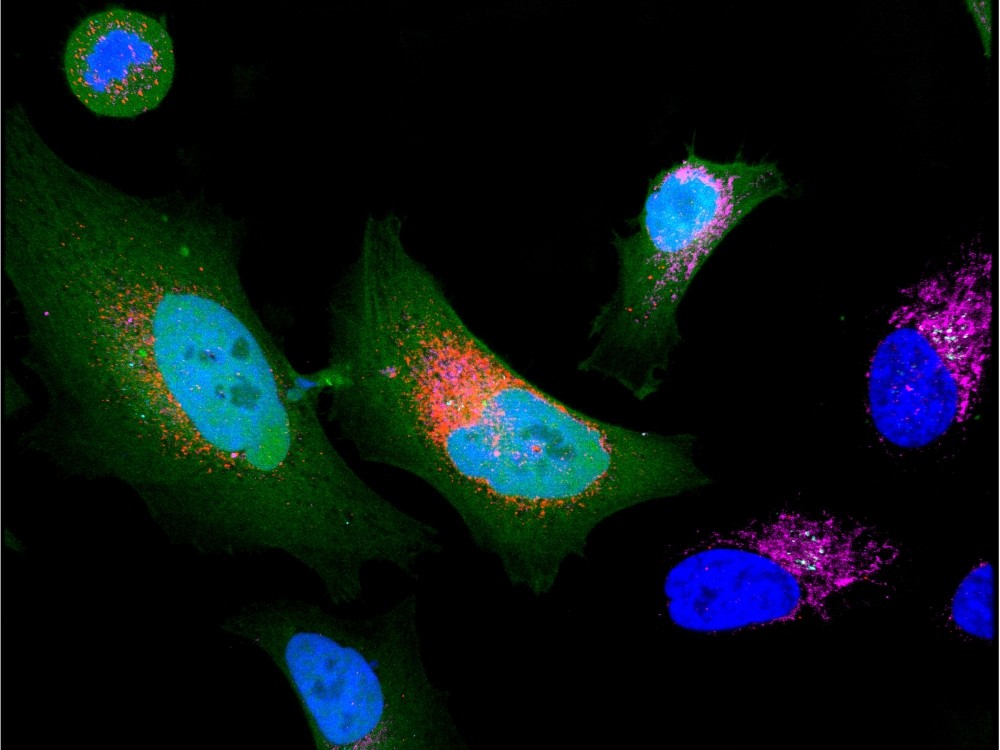
Photo : Ting Luo/Princess Máxima Center for pediatric oncology
A peptidein essential for cancer cell survival
Researchers identified a peptidein called OLMALINC that is essential for cancer cell survival. When it is removed, 85% of more than 485 cancer cell lines fail to survive. This peptidein comes from a gene once thought to be inactive and is involved in cell division and DNA repair. Its role in normal cells is still unknown.
A Global Scientific Collaboration, with IRCUS at the Heart of the Project
This breakthrough stems from an international scientific collaboration led by the TransCODE consortium, involving more than 60 researchers from over 30 institutions worldwide. The Université de Sherbrooke stands out as the only participating Canadian university, thanks to the involvement of Professor and Researcher Marie Brunet, who served as the principal investigator for the proteomics component of the study and as an executive member of TransCODE.
Three students from the laboratory of Professor and Researcher Marie Brunet—Valeriia Vasylieva, Félix‑Antoine Trifiro, and Francis Bourassa—also contributed directly to the work published in the journal Nature, in collaboration with Xavier Roucou, Professor and Researcher at IRCUS and the Department of Biochemistry and Functional Genomics at the FMSS.

Photo : Mathieu Lanthier - UdeS
A Massive and Rigorous Methodology
To establish a robust framework, the teams reanalyzed nearly 100,000 proteomics experiments. These analyses were carried out using very strict criteria and subsequently confirmed through precise validation methods. The results were then examined in depth to better characterize these proteins, including their evolutionary conservation, presence across different tissues, and biochemical properties. Together, this work represents the most comprehensive analysis to date of this long‑overlooked segment of the human proteome.
By making these data accessible via GENCODE and PeptideAtlas, the study provides the global scientific community with concrete tools to accelerate research for the benefit of people affected by cancer.
A New Era for Immuno‑Oncology
The study shows that many peptideins are detected using approaches that allow observation of peptides presented on the cell surface, a mechanism that is central to immune system recognition. To date, several of these peptideins have been observed in tumor samples or cancer cell lines, but not in healthy tissues.
These findings suggest that peptideins represent a promising biological potential to explore, notably to deepen our understanding of cancer and to develop more precise immunotherapy targets.
By revealing the existence of proteins that remained invisible to the scientific community for so long, this study changes the way research can explore, understand, and perhaps one day better fight not only cancer, but many other diseases as well.
About Marie Brunet
- Professor‑Researcher, Department of Pediatrics, Faculty of Medicine and Health Sciences, Université de Sherbrooke
- Professor and Researcher, Université de Sherbrooke Cancer Research Institute (IRCUS)
- Researcher, Centre de recherche du CHUS (CRCHUS)