IRC Innovations for a Sustainable Planet
$3.5 million in funding from the FRQ and strategic dialogues between UdeS and the CNRS
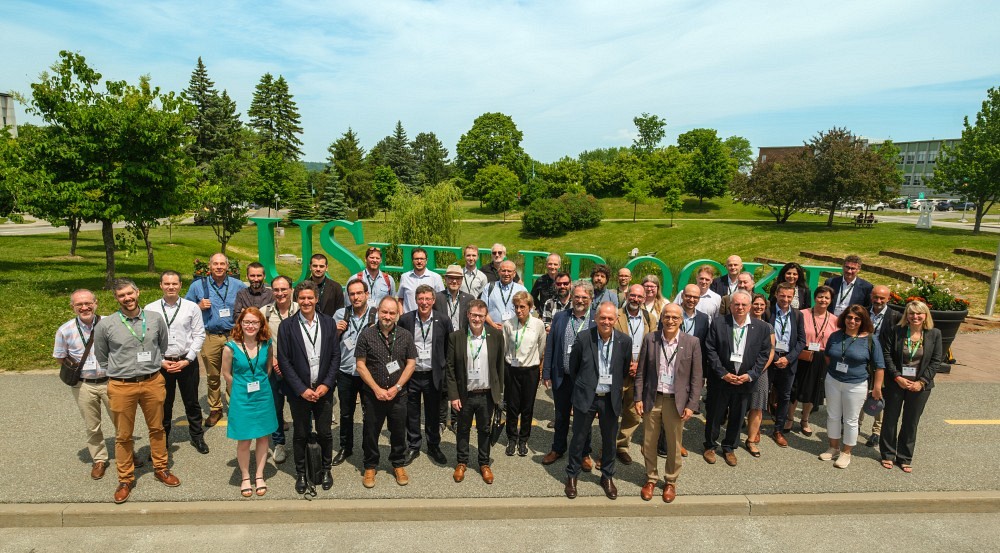
Teams from Quebec and France met on June 4 and 5 in Sherbrooke for the IRC’s first symposium,Innovations for a Sustainable Planet.
Photo : Michel Caron - UdeS
The new international research center (IRC) Innovation for a Sustainable Planet, launched in April, officially kicked off the deliberations that will lead to the planned sustainable innovations during a symposium held at UdeS on June 4 and 5, at which $3.5 million in funding was announced by the Fonds de recherche du Québec.
Quantum sciences and technologies, micro- and nanotechnologies, green chemistry and eco-materials, and responsible innovation and biodiversity: these are the four research areas through which UdeS and the CNRS will build this new bridge in research.
The Quebec and French teams that will develop these sustainable innovations met on June 4 and 5 in Sherbrooke to determine the priorities for the work to be carried out over the next few years within this IRC.
It is worth noting that the IRCInnovation for a Sustainable Planet, announced on April 12, 2024, is the 6thresearch center of its kind in the world and the 1stin Canada. UdeS is already home to two international research laboratories resulting from a partnership with the CNRS: the Nanotechnologies and Nanosystems Laboratory (LN2), launched in 2012, and the Quantum Frontiers Laboratory, established in 2022.
Research Built on Human Relationships
Antoine Petit, President and CEO of the French National Center for Scientific Research (CNRS), who was in Sherbrooke specifically for the occasion, believes that research is a vital link in the fight against climate change and that collaborations between UdeS and the CNRS form a solid foundation that will foster more innovations in sustainable development and prepare the next generation of scientists:
This IRC builds on working relationships that have existed for years between UdeS and the CNRS, as well as on personal relationships forged over time. The idea behind this IRC is to work on a critical issue—a topic that concerns us all. We must minimize our carbon footprint as much as possible without reducing our research activities. We will also invest in young people, training doctoral students who will be the researchers of tomorrow.
Antoine Petit, President and CEO of the CNRS
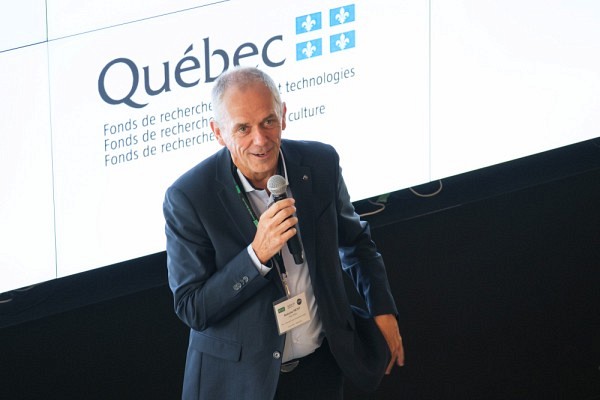
Present in Sherbrooke specifically for the occasion, Antoine Petit, President and CEO of the CNRS, believes that research is a crucial link in the fight against climate change.
Photo : Michel Caron - UdeS
Mr. Petit noted in passing that what sets the IRC’s research continuum apart is that it will cover the field of basic research while maintaining a close link with the industrial sector. Interdisciplinarity is also one of UdeS’s distinctive strengths in research, as is collaborative research:
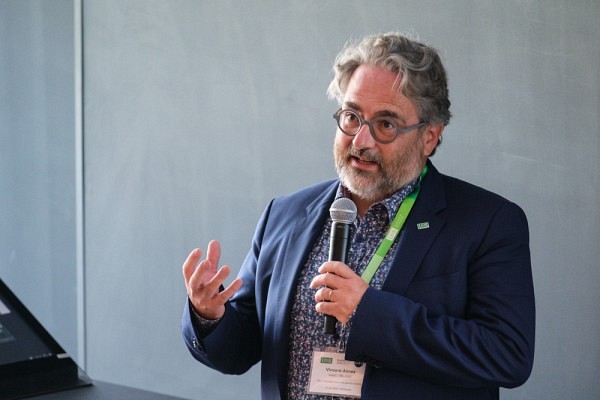
Professor Vincent Aimez, scientific director of the IRC and vice-rector for commercialization and partnerships at the University of Sherbrooke.
Photo : Michel Caron - UdeS
“Looking ahead 25 years: identifying now what we need to ensure a sustainable planet—that is the goal of this symposium,” explained Professor Vincent Aimez, the IRC’s scientific director and vice-rector for research translation and partnerships at the University of Sherbrooke, at the start of the event. “It aims to develop scientific collaborations rooted in longevity, innovation, and Francophone culture.”
$3.5 million for sustainable innovation at UdeS

Rémi Quirion, Chief Scientist of Quebec, took the opportunity to announce a $3.5 million grant from the Fonds de recherche du Québec (FRQ).
Photo : Michel Caron - UdeS
Also present, Rémi Quirion, Quebec’s Chief Scientist, took the opportunity to announce a significant grant from the Fonds de recherche du Québec (FRQ).
This new scientific bridge between France and Quebec heralds promising collaborations in highly strategic sectors, addressing major societal challenges on both sides of the Atlantic. In addition to the future development of sustainable innovations, research at this institution will be conducted in French, which reinforces the FRQ’s efforts in this regard. I extend my warmest congratulations to the Université de Sherbrooke for securing this first IRC on Canadian soil and wish the Quebec and French teams every success in their scientific work.
Rémi Quirion, Chief Scientist of Quebec
In the view of Professor Pierre Cossette, rector of UdeS, this funding will serve as a remarkable catalyst for advancing the research to be conducted at the IRC, while enabling UdeS to continue exercising unifying leadership around critical research themes.
Combining our innovation ecosystem with that of the CNRS can only lead to original solutions that pave the way toward a greener and more sustainable future.
Pierre Cossette, President of UdeS
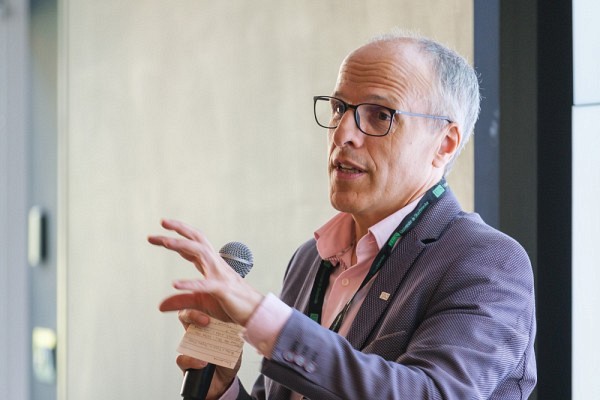
In the view of Professor Pierre Cossette, President of UdeS, this funding will serve as a remarkable catalyst for advancing the research to be conducted at the IRC.
Photo : Michel Caron - UdeS
All the ingredients are thus in place to create far-reaching projects and forge new transatlantic ties that will enable us to go even further.