Feature | IRC Innovations for a Sustainable Planet
Low-Carbon Concrete: Two Ph.D. Students at the Intersection of Chemistry and Sustainable Construction

Pierre-Luc Vallières is a doctoral student at the University of Sherbrooke, and Mathilde Robert is a doctoral student at the École supérieure de physique et de chimie industrielles de la ville de Paris (ESPCI Paris).
Photo : Courtesy of the author
Led by Professors Jérôme Claverie (Faculty of Sciences, UdeS) and Jean-Baptiste d’Espinose (SIMM ESPCI - UMR 7615, CNRS), the project “Bio-based DMSP Additives for the Decarbonation of Construction Materials” (DMSPdecarb) brings together two Ph.D. students, Mathilde Robert and Pierre-Luc Vallières, around a common goal: reducing the carbon footprint of construction materials. Their thesis projects, co-funded by UdeS and the CNRS as part of the “Innovations for a Sustainable Planet” IRC, focus on the development of innovative admixtures for clay-based concretes or raw earth construction materials.
The partnership between the CNRS and UdeS, strengthened by the creation in 2026 of a Center of Excellence on Low-Carbon Concrete (led by Prof. Arezki Tagnit-Hamou of the Faculty of Engineering at UdeS), demonstrates both institutions’ commitment to supporting ambitious scientific projects. At the intersection of chemistry and sustainable construction, their work aims to make these alternative materials more high-performing and better suited to construction requirements.
Concrete is ubiquitous in our cities, roads, and buildings. However, its production relies on cement, a material whose manufacturing generates considerable amounts of CO₂. To produce one metric ton of cement, limestone must be calcined (CaCO₃ → CaO + CO₂), a process that releases between 800 kg and one metric ton of carbon dioxide. Globally, the cement industry alone accounts for nearly 8% of global greenhouse gas emissions, making it one of the most difficult sectors to decarbonize.
Solutions exist, but they face a major technical challenge: replacing cement with alternative materials—such as calcined clays or raw earth—without compromising the properties essential for construction. This is precisely the challenge that the DMSPdecarb project aims to address by bringing together interdisciplinary teams combining fundamental chemistry, molecular modeling, and materials engineering.
The thesis projects of Mathilde Robert, a student at ESPCI Paris, and Pierre-Luc Vallières, a student at the University of Sherbrooke, focus on developing chemical admixtures capable of improving the dispersion of calcined clay particles in cementitious matrices—an essential condition for these alternative materials to compete, in terms of performance, with conventional concrete. Their backgrounds, their work, and their experiences studying in both Paris and Sherbrooke illustrate the scientific and human dynamics that drive this international research project.
Mathilde Robert: From Biology to Materials Chemistry
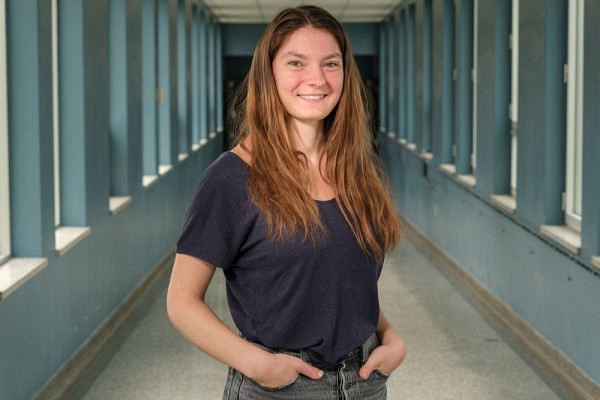
Mathilde Robert, a Ph.D. student at ESPCI Paris, is interested in using raw earth as a low-carbon construction material.
Photo : Courtesy of the author
Mathilde Robert’s career path was shaped by a family environment rooted in science. Her grandfather, a doctor, and her mother, a researcher at Sorbonne University specializing in batteries, instilled in her a passion for research at a very early age. Starting in middle school, she gravitated toward the life sciences and participated in theApprentis chercheursprogram, which allowed her to work one Wednesday a month on a biology research project focused on Duchenne muscular dystrophy: “It’s a program where you work once a month, every Wednesday afternoon, on a research project. For me, it was in biology, focusing on muscular dystrophy—a condition called Duchenne muscular dystrophy. I was really fascinated by it.”
In college, she began a bachelor’s degree in chemistry and life sciences at the University of Paris-Est-Créteil (UPEC), before gradually specializing in polymer chemistry, encouraged by a particularly inspiring professor. An internship during her first year of master’s studies in Nancy, focused on the chemical modification of wood to produce recyclable thermoplastic films, marked a decisive turning point. There, she obtained her first results in just a few days—whereas such syntheses typically take several months. She continued her studies with a second-year Master’s program at Sorbonne University, then enrolled at ESPCI Paris for her Ph.D., in partnership with the University of Sherbrooke—an institution she had discovered two and a half years earlier through a dual-degree program.
Pierre-Luc Vallières: From Scientific Curiosity to Applied Research
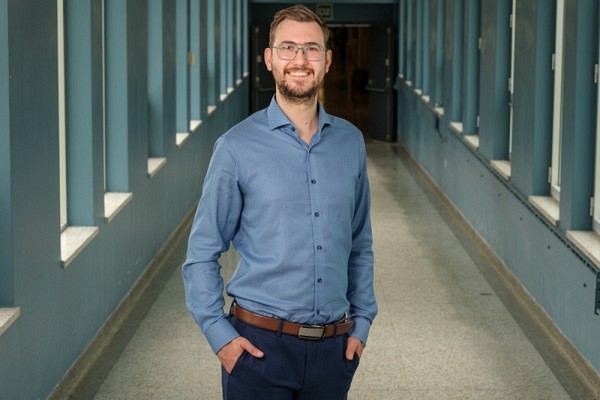
Pierre-Luc Vallières, a Ph.D. student at the University of Sherbrooke, is studying the possibility of using calcined clay in cement, which could significantly reduce CO2 emissions.
Photo : Courtesy of the author
Pierre-Luc Vallières attributes his passion for science to the magazineLesDébrouillards, which he read avidly as a child. “I had a subscription; every week my magazine would arrive, and I would read it very carefully. ” In high school, he wavered between several paths, including sports journalism, before discovering analytical chemistry during an open house at Cégep de Lévis. A passionate professor convinced him by showing him how to analyze the nutritional composition of food using laboratory instruments.
After three years of technical training, he completed a ten-week internship in Strasbourg, an experience that inspired him to pursue a university degree rather than enter the workforce directly. He enrolled at the University of Sherbrooke, drawn to its cooperative education program, and completed a series of internships: first in molecular modeling in Armand Soldera’s lab, then in materials science in Jérôme Claverie’s lab, where he worked with concrete for the first time. Upon completing his bachelor’s degree, he began a master’s program with Jérôme Claverie, followed by a Ph.D. as part of the DMSPdecarb project, after spending three to four months at ESPCI Paris to finalize his thesis.
Research Work Within the IRC Project
The Overarching Project: Reducing Concrete’s Carbon Footprint
The DMSPdecarb project tackles one of the most pressing environmental challenges of our time: reducing CO₂ emissions associated with cement production. This ubiquitous construction material relies on cement, the manufacture of which requires heating limestone and clay to approximately 1,450 °C. Prior to this, a chemical reaction takes place (CaCO₃ → CaO + CO₂), which releases, according to estimates, between 800 kg and one metric ton of CO₂ per metric ton of cement produced.
To reduce this footprint, the project is exploring two complementary approaches: partially substituting cement with calcined clays in cementitious matrices, and using raw earth—a naturally low-carbon material that is locally available and has been used in construction for millennia—as an alternative to cement. In both cases, a major technical challenge arises: once incorporated into a mixture, these materials tend to form aggregates that impair fluidity and mechanical properties.
If your clay or cement particles aren’t dispersed, they will aggregate. Water becomes trapped inside, so there is less water available to hydrate the cement and clay and to ensure proper mixing of the concrete. As a result, the concrete will have weaker mechanical properties and will be less fluid, making it more difficult to work with.
Pierre-Luc Vallières
The solution to this problem lies in the development of admixtures—chemical additives that improve particle dispersion and, by extension, the material’s performance. To this end, the DMSPdecarb project brings together teams from the University of Sherbrooke and ESPCI Paris in an interdisciplinary framework combining fundamental chemistry, molecular modeling, and materials engineering.
Ph.D. Projects: Two Approaches, One Goal
The dissertations of Mathilde Robert and Pierre-Luc Vallières address this shared challenge, though each focuses on a different material.
Pierre-Luc Vallières is working on incorporating calcined clays into cementitious matrices. His master’s thesis research has already demonstrated the ability to replace up to 60% of the cement with calcined clay, while maintaining mechanical properties and workability comparable to those of conventional concrete. His doctoral research aims to take this a step further by developing latex-type dispersants—small polymer particles that coat the surface of the clays to break up the aggregates and release trapped water. He also plans to use specialized equipment at ESPCI, notably to monitor cement hydration via NMR (nuclear magnetic resonance, an analytical technique used to study the structure and behavior of materials) in the solid state and to measure particle sedimentation rates using a Turbiscan-type device.
Mathilde Robert, for her part, is focusing on raw earth as a substitute for cement. This material, composed of clay, silt, and sand, has the advantage of being locally available and requiring no long-distance transport. Its main drawback is its sensitivity to moisture: depending on conditions, it can swell, crack, or soften. To address this, she is developing surfactants—small molecules that intercalate between the clay layers to limit swelling and improve dispersion.
Clays undergo flocculation and coagulation. Depending on the type of clay, they will swell to a greater or lesser extent based on their internal cation content. Additives can be added to limit this swelling and produce a more suitable clay.
Mathilde Robert
The two doctoral students share the same starting molecule, derived from phytoplankton, which they chemically modify via distinct synthetic pathways to obtain their respective additives. One of the current challenges is to make these molecules bio-based, in order to reduce reliance on petrochemicals and strengthen the environmental sustainability of the entire process.
Finally, the pair emphasizes the value of the direct exchanges made possible by these joint visits. By working in parallel on different synthetic pathways for the same starting molecule, they can compare their results, quickly identify what works and what doesn’t, and adjust their approach in real time—a dynamic that is difficult to replicate remotely, given the time difference and the availability constraints that come with it.
Academic Life, International Mobility, and Cross-Cultural Experiences
The collaboration between ESPCI Paris and UdeS is not limited to scientific exchanges: it involves research stays that enrich both the professional and personal journeys of the two doctoral students.
Mathilde Robert is currently on her second visit to Sherbrooke as part of the IRC. These visits give her access to characterization equipment—particularly NMR devices—that are not available in her Parisian lab, the ESPCI Laboratory of Soft Matter Science and Engineering (SIMM): “In Paris, to use a carbon NMR, you sometimes have to wait five days. Here, the machine is available—it takes two minutes.” She has also been able to receive hands-on training in using these instruments, which significantly speeds up the pace of her work.
Pierre-Luc Vallières, for his part, is planning a trip to Paris in November. There, he will use a particularly high-performance solid-state NMR machine to monitor the hydration of cements, as well as an instrument for measuring sedimentation rates—two pieces of equipment that the University of Sherbrooke does not have at an equivalent level. He will also benefit from the expertise of Jean-Baptiste d’Espinose, Mathilde’s co-advisor and a recognized specialist in NMR analysis of cements.
Beyond the technical aspects, these stays offer a contrasting life experience that both researchers appreciate in their own way. Mathilde, accustomed to the fast pace of Paris, appreciates Sherbrooke’s more relaxed atmosphere, its green spaces, and its different lifestyle: “Life in Paris is very stressful. Here, the environment is completely different. Knowing there’s greenery all around—an environment where you can breathe—feels good.” ” Pierre-Luc, a sports enthusiast—basketball, spikeball, volleyball—takes full advantage of Sherbrooke’s outdoor spaces, while looking forward with interest to the historical and cultural richness of Paris. He also serves as coordinator of a college basketball league, a role that demonstrates his commitment beyond the laboratory.
A Strategic Issue for Sustainable Construction
In post-industrial societies, construction remains a major aspect of economic development, whether it involves new developments or the maintenance of existing infrastructure. In this context, issues related to global warming are of growing concern to major players in the energy and industrial sectors.
The doctoral projects of Mathilde Robert and Pierre-Luc Vallières are thus part of a broader trend, in which the demand for low-carbon solutions in construction is set to grow. Their work addresses a growing need: to develop materials with lower carbon footprints without compromising the performance requirements specific to the construction sector.