Review and perspectives for 2024-2027 | IRC Innovations for a Sustainable Planet
An exceptional scientific collaboration between the CNRS and the University of Sherbrooke
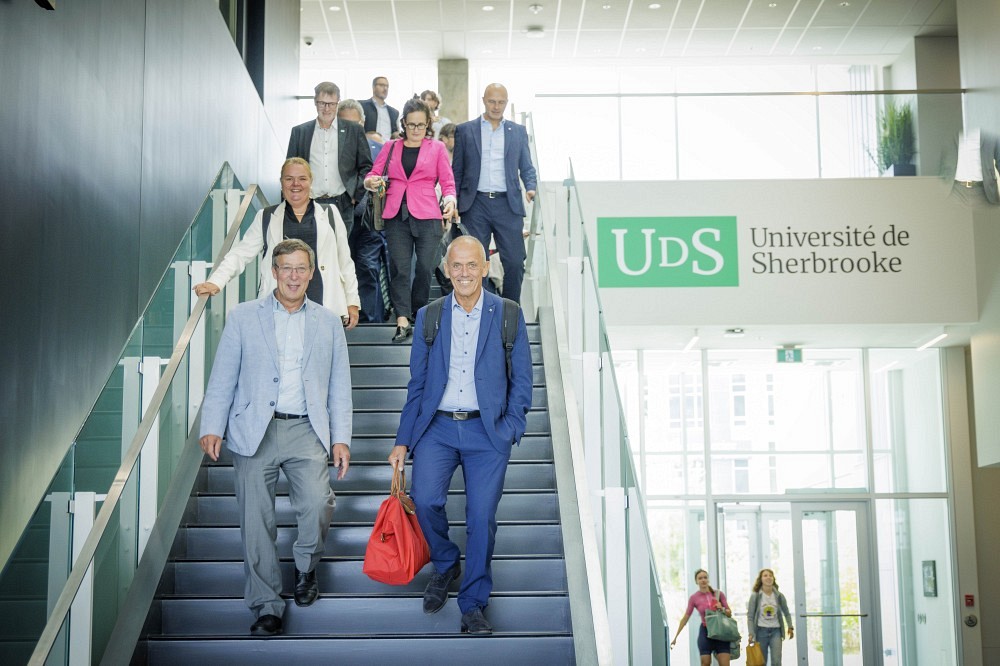
The rector of UdeS, Prof. Jean-Pierre Perreault, hosted the CEO of the CNRS, Prof. Antoine Petit, during a meeting that took place at 3iT and continued at the Pavilion for Precision Health and Translational Research (PSPRT) at UdeS’s Faculty of Medicine and Health Sciences (FMSS).
Photo : Mathieu Lanthier - UdeS
On August 27, 2025, the University of Sherbrooke hosted a high-level meeting between Prof. Antoine Petit, President and CEO of the National Center for Scientific Research (CNRS), and Prof. Jean-Pierre Perreault, Rector of UdeS, in the presence of Prof. Anne Lessard, Vice-Rector for Research and International Relations at UdeS.
The CNRS delegation also included Lionel Buchaillot (Director of CNRS Engineering), Nicolas Douay (Scientific Attaché at the Consulate General of France in Montreal), Andréa Dessen (Director of the CNRS Office in Canada), and Suzie Bronner (Cooperation Officer at the CNRS Office in Canada).
On the morning of the meeting, presentations were given by Bernard Legrand and Prof. Vincent Aimez (scientific directors of the IRC for the CNRS and UdeS), Prof. Louis Taillefer (IRL Frontières Quantiques), Prof. Denis Machon (IRL LN2), Fabien Alibart and Rémi Dreyfus (CNRS), Prof. Armand Soldera (Dean of Sciences at UdeS), as well as UdeS professors co-supervising UdeS-CNRS theses funded through the IRC.
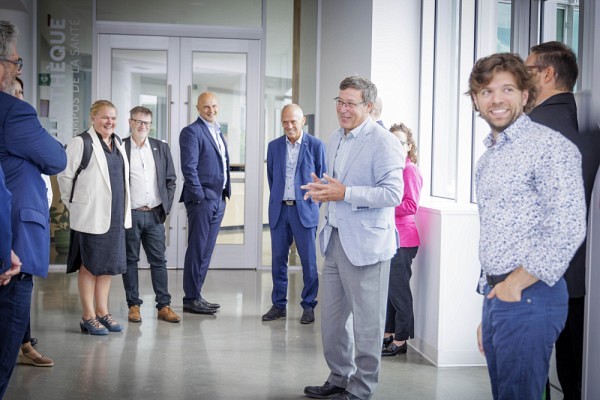
Remarks by the UdeS Rector, Prof. Jean-Pierre Perreault, during the visit to the Precision Health and Translational Research Pavilion (PSPRT) at the Faculty of Medicine and Health Sciences (FMSS).
Photo : Mathieu Lanthier - UdeS
In the afternoon, the CNRS delegation was welcomed at the UdeS Faculty of Medicine and Health Sciences (FMSS) campus by Prof. Louis Valiquette (Dean, FMSS–UdeS), Prof. Christian Iorio-Morin (Surgery, FMSS-UdeS), and Marie-Claude Battista (Director of the Office of Commercialization and Partnerships, FMSS-UdeS). The discussions highlighted the strong potential for collaboration between the CNRS and UdeS in the fields of digital health and medicine, at the intersection with engineering, entrepreneurship, and technological innovation.
This meeting marked an important milestone in the development of the IRC “Innovations for a Sustainable Planet,” a partnership dedicated to responsible innovation that exemplifies the excellence of the scientific relationship between UdeS and the CNRS.
Opening Remarks: A Shared Vision for the Future
Rector Jean-Pierre Perreault opened the meeting by emphasizing the strategic importance of this collaboration: “Let’s build something that will be a driving force for the future. Something that will be strong, that will truly enable us to conduct high-quality science at the very highest level.” He announced the submission of a proposal for a chair in scientific diplomacy with the University of Grenoble-Alpes, funded by the Fonds de recherche du Québec, which will be centered around the IRC.

The rector of UdeS, Prof. Jean-Pierre Perreault, addressing the CNRS delegation.
Photo : Michel Caron - UdeS
The rector particularly emphasized the credibility provided by the partnership with the CNRS: “It is one of the world’s leading research institutions. We have two joint laboratories. We have the IRC. That actually lends a great deal of credibility to the work we do.” His vision goes beyond mere scientific excellence to embrace societal impact: “doing good science, but above all for the benefit of society.”
This approach is part of a broader strategy of scientific diplomacy, in which the IRC becomes a vehicle for innovation in the service of major global challenges. The rector emphasized the importance of transforming research into “societal innovation,” moving beyond mere scientific publication to create a tangible impact on society.

CNRS CEO Prof. Antoine Petit addressing a diverse scientific audience from the CNRS and the UdeS.
Photo : Michel Caron - UdeS
Antoine Petit highlighted the exceptional continuity of France-Quebec relations: “In this geopolitical context, which is certainly complicated and ever-changing, these relations between Quebec and France are absolutely unique .” He noted that this relationship transcends individuals and is built to last, enabling the training of generations of researchers.
Antoine Petit placed the IRC within the context of the CNRS’s six international research centers around the world, alongside the University of Chicago, the University of Arizona, Imperial College London, the University of Tokyo, and the University of São Paulo. He reaffirmed the CNRS’s motto: “Basic research in the service of society,” emphasizing that this research is not disconnected from social concerns.
This vision is grounded in a deep understanding of contemporary issues, where science must address global challenges while maintaining excellence in basic research. The president of the CNRS emphasized the importance of these international structures, which “reflect scientific reality” and enable the expansion of existing collaborations.
Strategic Vision and Foundations of the IRC
Bernard Legrand, the IRC’s CNRS Scientific Director, presented an overview of the launch and organizational phase. The defining moment was the June 2024 workshop, which brought together some 50 people in Sherbrooke and helped define the four thematic pillars:
- Responsible innovation, transitions, and biodiversity
- Micro- and nanotechnologies
- Sustainable chemistry and circularity of materials — Responsible, low-carbon materials for sustainable construction
- Quantum sciences and technologies

Bernard Legrand, a research director at the CNRS, serves as the Scientific Director of the IRC “Innovations for a Sustainable Planet” on behalf of the CNRS.
Photo : Michel Caron - UdeS
A survey conducted among three CNRS institutes (engineering, physics, and chemistry) revealed that 80 CNRS laboratories have collaborative relationships with UdeS. This solid foundation attests to the existing dynamism and offers opportunities for targeted collaboration.
The IRC’s vision is ambitious: “for the IRC ‘Innovations for a Sustainable Planet’ to become the spearhead of ambitious, international, and interdisciplinary scientific projects aimed at addressing global challenges.” Canada’s participation in the Horizon Europe program—particularly in Pillar 2, which focuses on the Sustainable Development Goals—opens up new funding opportunities.
The first call for proposals for the “Ph.D. Joint Program” demonstrated the initiative’s capacity for collaboration, with 10 submissions from as many different CNRS laboratories, involving nearly as many UdeS departments. This diversity perfectly illustrates the interdisciplinary approach promoted by the IRC and its ability to broadly mobilize scientific communities on both sides of the Atlantic.

Prof. Vincent Aimez (UdeS) is the Scientific Director of the IRC “Innovations for a Sustainable Planet” for UdeS, and Vice-Rector for Commercialization, Partnerships, and Sustainable Development at UdeS.
Photo : Michel Caron - UdeS
Prof. Vincent Aimez, UdeS Scientific Director of the IRC, highlighted the agile nature of the IRC’s structure. The partnership with the Alain Aspect Symposium serves as a prime example: “When we had the opportunity to become a partner of the Alain Aspect Symposium, established in November 2023 in Sherbrooke, we had the privilege of awarding him an honorary doctorate.”
This collaboration led to the launch of the Alain Aspect Chair, with two holders—one at the Institut d’Optique in France and one at the University of Sherbrooke—funded by Nord Quantique and Pasqal. Participation in VivaTech 2025 helped raise the international profile of France-Quebec collaborations in the quantum field, featuring a discussion on how to combine scientific excellence, France-Quebec collaboration, and innovation.
This approach is part of a broader strategy to develop Sherbrooke’s quantum ecosystem, which benefits from a particularly favorable environment thanks to the Quantum Institute, the presence of innovative companies such as Nord Quantique, and partnerships with Pasqal.
Scientific Excellence and Existing Synergies
Prof. Louis Taillefer: The IRL Frontières quantiques, a Model of Collaboration
The IRL Frontières Quantiques, established in January 2022 by the CNRS, brings together 69 researchers spread across Canada (19 members from UdeS) and France (50 researchers from 12 laboratories). This organization focuses on two main areas: quantum materials, and quantum circuits and devices.

Prof. Louis Taillefer (UdeS), director of the IRL Frontières Quantiques.
Photo : Michel Caron - UdeS
The collaboration mechanisms are diverse: 4 researchers on exchange for three and a half years, 8 jointly supervised doctoral theses, 5 jointly supervised fellowships, and 49 French interns who have come to Sherbrooke. The flagship scientific project focuses on the pseudogap phase of cuprate superconductors, with an ANR-NSERC collaboration (2024–2027).
The IRL Frontières Quantiques draws inspiration from the collaborative model developed by CIFAR, the Canadian Institute for Advanced Research, whose quantum materials program has been in existence since 1987 and has just been renewed for an eighth five-year term, representing 40 years of international collaboration based on diversity, trust, and camaraderie. The IRN CAFQA (Canada-France Quantum Alliance), created by the CNRS in 2023, extends the collaborative model beyond Sherbrooke to all of Canada, with the IRL Frontières quantiques playing a very active role in its development, as two of its members are among the four on the executive committee.
This collaboration illustrates the fruitful interface between quantum materials and quantum technologies. In particular, the “Megagauss” project aims to achieve magnetic fields exceeding 150 Tesla to completely eliminate superconductivity and reveal the nature of the pseudogap phase. This fundamental research could revolutionize our understanding of high-critical-temperature superconductors.
Prof. Denis Machon: Synergy Between the IRC and the LN2
The Nanotechnologies and Nanosystems Laboratory (LN2), an international CNRS laboratory fully integrated into the UdeS, has 150 members. Its new scientific structure is based on three areas of technological expertise (nanoelectronics, nanophotonics, nanomaterials) and two cross-cutting themes: heterogeneous integration and advanced microfabrication; and applications, impacts, and societal implications.

Prof. Denis Machon (UdeS and INSA Lyon) is the director of the IRL LN2.
Photo : Michel Caron - UdeS
The IRC has fostered new collaborations within the LN2, notably with the IRP Centre Acoustique Jacques Cartier, leading to funding for two projects on environmental mapping.
This cross-disciplinary approach perfectly illustrates Sherbrooke’s philosophy, which combines technological excellence with societal impact. The LN2’s organization around cross-disciplinary themes facilitates dynamic interaction between basic research and practical applications, as demonstrated by Fabien Alibart and Rémi Dreyfus, CNRS researchers assigned to the LN2.
Fabien Alibart: Neuromorphic Computing and Frugal AI
Fabien Alibart (CNRS research fellow) presented the IEMN-LN2 collaboration, launched in 2017, which resulted in a joint MEIE chair in neuromorphic computing (2021–2026). This approach combines hardware and algorithmic methods to develop a new generation of AI, drawing inspiration from biological concepts to create third-generation neural networks.

Fabien Alibart, CNRS research fellow and co-holder of the Chair in Neuromorphic Computing at UdeS.
Photo : Michel Caron - UdeS
Applications target sensor networks for environmental monitoring and smart grids for energy and connected cities. The project has led to an ANR grant, two European projects, three Canadian projects, more than 14 students, and six major publications, as well as the creation of a startup.
This research aligns perfectly with the IRC’s objectives by offering AI solutions that are more energy-efficient and tailored to environmental challenges. The neuromorphic approach offers promising prospects for the development of more sustainable artificial intelligence.
Rémi Dreyfus: Innovation for Environmental Monitoring
Rémi Dreyfus (research director at the CNRS) summarized a project to detect mercury in the Arctic. This collaboration with the IRL Takuvik aims to develop collectors that can concentrate mercury on-site rather than bringing dozens of liters of water back to research vessels.

Rémi Dreyfus, research director at the CNRS.
Photo : Michel Caron - UdeS
The material developed consists of colloids coated with gold nanoparticles capable of capturing mercury at oxidation states 0 and 2. Version 2 will incorporate a spectrometer to directly measure fluorescence and absorption, enabling measurements to be taken directly at the sampling site.
This project illustrates how technological innovation can address concrete environmental challenges. Direct collaboration with end users (the Takuvik research team) exemplifies the IRC’s pragmatic approach, where basic research meets operational needs.
Prof. Armand Soldera: Green Chemistry and Opportunities for Excellence
The dean of the UdeS Faculty of Sciences highlighted the optimal conditions for a new wave of scientific excellence in chemistry. The department collaborates with more than 20 CNRS laboratories, notably the IRL LN2, on a jointly supervised dissertation on plasmonic sensors in nanocapsules.

The dean of the UdeS Faculty of Sciences, Prof. Armand Soldera.
Photo : Michel Caron - UdeS
Armand Soldera’s vision is ambitious: to create “a center of global influence, the result of pooling our strengths, driven by excellence and innovation.” The synergy between chemistry, quantum science, and nanotechnology transcends disciplinary boundaries to become “a driver of innovation to address the challenges of the 21st century” .
The potential for collaboration in chemistry and the sciences between the CNRS and UdeS was highlighted by Prof. Armand Soldera, who emphasized the significant added value provided by students coming from France to complete their engineering training at UdeS and who leave with a master’s degree.
This interdisciplinary approach builds on the excellence already demonstrated by the Faculty of Sciences, where 96% of professors receive research funding and the faculty holds a remarkable position in international rankings.
Joint Thesis Program: First Concrete Achievement of the “PhD. Joint Program” 2025
The meeting highlighted three innovative projects led jointly by thesis candidates at UdeS and the CNRS, with each project targeting a concrete impact of interdisciplinary research on current environmental and technological challenges. Generous financial support from the Fonds de recherche du Québec (FRQ) enables the IRC to fund dissertations led by UdeS faculty members.
This demonstrates the network’s ability to mobilize diverse expertise to address major challenges, ranging from green chemistry to emerging technologies. The initiatives presented reflect a collective commitment to combining scientific excellence with sustainable solutions for the 21st century.
Jérôme Claverie: Bio-based DMSP Additives for Decarbonization
Prof. Jérôme Claverie (Chemistry, UdeS) presented the “DMSPdecarb” project, which involves the development of bio-based additives for low-carbon construction materials. This interdisciplinary collaboration (Chemistry and Civil Engineering, UdeS; UMR CNRS 7615, SIMM ESPCI) uses DMSP (dimethylsulfoniopropionate), “the most abundant marine organic compound on Earth.”

Prof. Jérôme Claverie (Chemistry, Faculty of Sciences, UdeS).
Photo : Michel Caron - UdeS
The innovation lies in using this sulfur-containing compound to make clays compatible with cement and to protect green clay from re-absorbing water. The carbon footprint of these bio-based admixtures (≤ 1 kgCO2-eq/kg) is significantly lower than that of current commercial admixtures (~ 2 kgCO2-eq/kg).
This project illustrates the IRC’s approach, which combines scientific innovation with environmental impact. In the context of decarbonization, the use of an abundant marine resource to solve a major problem in the construction industry demonstrates the potential of interdisciplinarity.
Allison Wustrow: Aluminum-Air Batteries, a Multiscale Approach
Prof. Allison Wustrow (Chemistry, UdeS) provided an overview of the “Evaluating Aluminum Energy” project, which takes an “electrons-to-market” approach. Aluminum is approximately 1,000 times more abundant than lithium, costs one-fourth as much, and offers comparable—or even superior, depending on the criteria used—capacity.

Prof. Allison Wustrow (Chemistry, Faculty of Sciences, UdeS).
Photo : Michel Caron - UdeS
The multidisciplinary team (Chemistry and Chemical Engineering at UdeS, IRDL Mechanical Systems Laboratory UMR CNRS 6027,
Laboratory of Information, Communication, and Knowledge Sciences and Technologies UMR CNRS 6285) is studying aluminum alloys to minimize unwanted reactions, conduct commercial-scale testing, and assess the social acceptability of this technology. This multi-scale approach illustrates the interdisciplinary nature promoted by the IRC.
The project demonstrates how fundamental materials research can be integrated into a comprehensive approach that encompasses technological, economic, and societal aspects.
Marie-Luc Arpin: The ECO-LIB Project and Interdisciplinarity
Prof. Marie-Luc Arpin (Management, UdeS) demonstrated how the ECO-LIB project represents an example of so-called “distal” interdisciplinarity, integrating the humanities and social sciences (Management and Mechanical Engineering, UdeS; Charles Gerhardt Institute of Montpellier, UMR CNRS 5253, and Hydrosciences Montpellier, UMR CNRS 5151, IMT Mines Alès).

Prof. Marie-Luc Arpin (Management, School of Management, UdeS).
Photo : Michel Caron - UdeS
This project aims to eco-design lithium-ion batteries by replacing problematic anode components with silicon derived from recycled materials (silicon from end-of-life photovoltaic panels and germanium from microelectronics manufacturing).
The second of the project’s two dissertations develops a life-cycle assessment (LCA) framework expanded to include social dynamics, anticipating impact shifts, threshold effects, and rebound effects. This approach redefines the status of the LCA model, transforming it into “a frontier object, no longer a sort of guarantor of truth in decision-making.”
This project pushes interdisciplinarity beyond traditional collaborations between science and engineering to truly integrate the humanities and social sciences. This “distal” approach presents a methodological challenge but opens up new perspectives for truly responsible innovation.
Outlook for 2025–2027 and Beyond
Strategic Objectives
The IRC has three main objectives: to develop a dynamic IRC community, to capitalize on funding opportunities (notably Horizon Europe), and to foster projects with a strong global impact.
The first call for proposals under the joint thesis program demonstrated the capacity for collaboration between CNRS laboratories and UdeS departments, with projects that broadly cover the IRC’s thematic scope.
This diversity attests to the IRC’s ability to broadly mobilize scientific communities beyond traditional collaborations. Interdisciplinarity is not merely an objective but is becoming an operational reality.
Short-Term Initiatives (2025–2026)
Thanks to financial support from the Fonds de recherche du Québec (FRQ), up to three additional projects resulting from the first call for proposals could receive co-funding from UdeS and CNRS laboratories: automated sensors for Arctic environmental monitoring, the topology of non-collinear altermagnets, and the accelerated adoption of low-carbon concrete.

CNRS CEO Prof. Antoine Petit, accompanied by UdeS Rector Prof. Jean-Pierre Perreault.
Photo : Michel Caron - UdeS
The second call for proposals will be launched by early this fall, funding six additional doctoral dissertations for 2026.
The co-funding approach for these additional projects demonstrates the IRC’s flexibility and its ability to adapt to opportunities. This strategy maximizes the impact of the joint program’s first call while laying the groundwork for future calls.
Upcoming events include the Alain Aspect Symposium (UdeS, spring 2026), the IRL LN2 conference (France, July 2026), and a virtual IRC conference in October 2026. This event strategy helps maintain the IRC’s momentum amid its strategic development.
Medium-Term Vision
The idea of a network of the six CNRS IRCs is taking shape, with opportunities for student exchanges and inter-IRC collaborations already underway.Le Climatoscope, a popular science journal published by UdeS, could serve as a model for IRC communication on a global scale.

The scientific directors of the “Innovations for a Sustainable Planet” IRC for the CNRS and UdeS presented a strategic vision for the IRC’s development.
Photo : Michel Caron - UdeS
The first IRC symposium, “Innovations for a Sustainable Planet,” is planned for 2027, by which time two to three generations of students will have been trained through research. By then, the number of researchers involved will be considerable, as each thesis in the joint program is co-supervised by two researchers working together across France and Quebec.
Conclusion
The IRC “Innovations for a Sustainable Planet” exemplifies the model of innovation and international scientific excellence promoted by the CNRS and the University of Sherbrooke. The expected impact goes beyond simply training a new generation of researchers. It aims to make a concrete contribution to global sustainable development challenges.
As announced by Prof. Jean-Pierre Perreault, the goal is to “do good science, but above all for society,” transforming scientific innovation into societal innovation. This exceptional collaboration between France and Quebec, highlighted by Prof. Antoine Petit, demonstrates that, in a complex geopolitical context, lasting scientific relationships are a valuable asset for the advancement of knowledge and the well-being of humanity.
The success of the IRC’s first year of operation—marked by the launch of six joint doctoral theses and numerous emerging collaborations—bodes well for the future of this Franco-Quebec initiative.