Université de Sherbrooke AccueilPlan des campusBottin universitaireÉcrivez-nous...sur l'Université de Sherbrooke
 Accueil   La recherche   Programmes d'enseignement   Corps professoral   Séminaires   Nouvelles   Accès routiers   Historique du département   Équipes de recherche 

Sherif Abou Elela
Brendan Bell
Benoit Chabot
Antonio Conconi
Louis-Charles Fortier
Eric Frost
Roscoe Klinck
Kerri Kobryn
Sophie Michaud
Jacques Pépin
Alain Piché
Claudine Rancourt
Louis Valiquette
-Raymund J. Wellinger
Isabelle Alarie
Raymond Duperval
Louise Dion


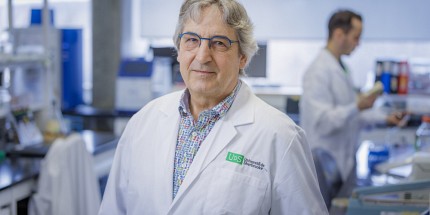
WELLINGER Raymund J., Ph.D.

Professeur titulaire et Directeur

Ph.D., Université de Lausanne, Suisse (1986)

Formation postdoctorale, Fred Hutchinson Cancer Research Center, Seattle, WA (1992)

Raymund.Wellinger@USherbrooke.ca


LA RÉPLICATION DES TÉLOMÈRES

English version

La recherche dans notre laboratoire touche la fin des chromosomes eucaryotes, les télomères. Ces structures particulières sont essentielles pour la stabilité du génome humain. De plus, une dégradation des télomères lors du vieillissement humain est associée à la sénescence cellulaire. Par contre, dans les cellules germinales, il y a un mécanisme de rattrapage pour contrecarrer ces pertes. Ce mécanisme implique l'enzyme télomérase qui agit sur l'ADN particulière constituant les télomères,. La télomérase est composée de différentes sous-unités protéiques et au moins une molécule ARN essentielle. Chez l'humain encore, une activation de la télomérase lors de la cancérogénèse contribue de façon importante au développement du cancer en permettant aux cellules cancéreuses de se diviser sans limite (immortalité). Donc cette enzyme demeure une cible préférée et très prometteuse dans les efforts pour trouver des nouvelles approches anticancéreuses.

Donc, la plupart des projets dans le laboratoire visent à comprendre les relations entre la réplication conventionnelle, les points de contrôle (checkpoints) du cycle cellulaire et la réplication des télomères. De plus, des analyses structurales des fins des chromosomes devront nous permettre de comprendre les mécanismes moléculaires.

Nous utilisons la levure, Saccharomyces cerevisiae comme système cellulaire car cet organisme permet l'utilisation des techniques de biochimie, biologie moléculaire, génétique moléculaire et microscopie en même temps.

Nous collaborons avec plusieurs groupes de recherche au Canada ainsi qu'en France, Danemark, Israël, République Slovaque et aux États-Unis. À Sherbrooke, les groupes de S. Abou-Elela, B. Chabot et A. Conconi s'intéressent aussi à des questions touchant des télomères et nous collaborons avec des chercheurs-cliniciens (H. Knecht et G. Boire pour investiguer des relations entre les télomères et certaines maladies humaines (cancer et arthrite aigue).

The research in our lab is centered on questions relating to the termini of eukaryotic chromosomes, the telomeres. These particular structures are highly conserved in structure and function amongst many eukaryotes and they are essential for genome stability. For example, in aging humans, telomeres become progressively degraded and the shortened telomeres have been associated with human cellular senescence. On the other hand, in human germinal cells there is a mechanism allowing counteracting these losses. The mechanism is based on the enzyme telomerase which will act and replenish the special telomeric DNA repeats. The telomerase holo-enzyme is composed of a number of protein subunits plus at least one RNA molecule. Again, in humans, the reactivation of telomerase during cancer development contributes an essential property to cancer cells, namely that of a virtually endless capacity to divide (immortality). Therefore, telomerase still remains a preferred target for the development of new anti-cancer treatments.

Thus, major projects in the lab concern the interrelation of conventional replication and cell cycle checkpoints with telomere replication. Furthermore, structure analyses of chromosome ends should reveal insights into the molecular mechanisms at hand.

Virtually all of this work uses Saccharomyces cerevisiae as a model system. This organism allows us to combine biochemical with molecular genetic and microscopic techniques and we have developed several new techniques to analyze telomere biology.

We collaborate with many groups in Canada and other parts of the world (France, Denmark, Israel, Slovakia and the USA). In Sherbrooke, the groups of S. Abou Elela, B. Chabot and A. Conconi are also interested in questions relating to telomeres and we also collaborate with clinician-researchers on direct links between telomere biology and human disease, in particular cancer, haematological disorders and acute arthritis.

Publications récentes

Nosek J., Gunisova S., Lucier J.-F., Elhanan E., Wellinger R.J.*, Tzfati Y.* and Tomaska L.* (2008). Comparative analysis of telomerase RNA in yeast species with large telomeric repeats. RNA (sous presse). *Co-Communicating PI.

Knecht H., Swan B., Lichtensztejn D., Lemieux B., Wellinger, R.J. and Mai S. (2008). The 3D nuclear organization of telomeres marks the transition from Hodgkin to Reed-Sternberg cells. Leukemia.Online:doi:10.1038/leu.2008.314.

Klinck R., Bramard A., Inkel L., Dufresne-Martin G., Gervais-Bird J., Madden R., Paquet E.R., Prinos P., Jilaveanu-Pelmus M., Rancourt C., Wellinger R.J., Chabot B. and Abou Elela, S. (2008). An integrated system for the discovery of ovarian cancer-associated splicing patterns. Cancer Research 68(3), 657-663.

Gallardo F., Olivier C., Dandjinou A., Wellinger, R.J. and Chartrand P. (2008). A Crm1p-dependent pathway excludes misassembled telomerase from the nucleus. EMBO J 27, 48-757.

Parenteau J., Durand M., Véronneau S., Lacombe A.-A, Morin G., Guérin V., Cecez B., Gervais-Bird J., Koh C.-S., Brunelle D., Wellinger R.J., Chabot B.* and Abou Elela S.* (2008). Systematic deletion of many yeast introns reveals a minority of genes that require splicing for function. Molecular Biology of the Cell 19, 1932-1941. (*Co-PIs).

Venables J.P., Klinck R., Bramard A., Inkel L., Dufresne-Martin G., Koh C-S., Gervais-Bird J., Lapointe E., Froehlich U., Durand M., Gendron D., Brosseau J.-P., Thibault P., Lucier J.-F., Tremblay K., Prinos P., Wellinger R.J., Chabot B., Rancourt C. and Abou Elela S. (2008). Identification of alternative splicing markers for breast cancer. Cancer Research 68, 9525-9531.

Larose S., Laterreur N., Ghazal G., Gagnon J., Wellinger R.J. and Abou Elela S. (2007). RNase III-dependent regulation of yeast telomerase. J. Biol. Chemistry 282(7),4373-4381.

Larrivée M. and Wellinger R.J. (2006). Telomerase- and Capping independent yeast survivors with alternate telomere states.Nature Cell Biology 8, 741-747.

Toussaint, M., Levasseur, G., Gervais-Bird, J., Wellinger, R.J., Abou Elela, S., Conconi, A. (2006). A high-throughput method to measure the sensitivity of yeast cells to genotoxic agents in liquid cultures. Mutat Res. 606 (1-2), 92-105.

Vodenicharov, M. and Wellinger R.J. (2006). DNA-degradation at unprotected telomeres in yeast is regulated by the CDK1 (CDC28/Clb) cell cycle kinase. Molecular Cell 24, 127-137.

Berthiau A.-S., Yankulov K., Bah A., Revardel E., Wellinger R.J., Géli V. and Gilson É. (2006). Subtelomeric proteins negatively regulate telomere elongation in budding yeast: evidence for an antagonism between transcriptional activators and telomerase. EMBO Journal 25, 846-856

LeBel C., and Wellinger R.J. (2005). Telomeres: what's new at your end? Journal of Cell Science 118, 2785-2788.

Chakhparonian M., Faucher D. and Wellinger R.J. (2005). A new yeast TEL1-allele with differential effects on the DNA damage TM-checkpoint and telomere maintenance. Current Genetics 48 (5), 310-322.

Parenteau J., Klinck R., Good L., Langel U., Wellinger R.J.* and Abou Elela S.* (2005). Free uptake of cell-penetrating peptide by fission yeast. FEBS Letters 579(21), 4873-4878 (*Co PIs).

Toussaint M., Dionne I. and Wellinger R.J. (2005). Limited TTP-supply affects telomere length in a telomerase-independent fashion.Nucleic Acids Research 33(2), 703-714.

Patry C., Lemieux B., Wellinger R.J.* and Chabot B.* (2004). Targeting hnRNP A1 and A2 by RNA interference promotes cell death in transformed but not normal mouse cell lines. Molecular Cancer Therapeutic 3(10), 1193-1199 (*Co PIs).

Dandjinou A.T, Lévesque N., Larose S., Lucier J.F., Abou Elela S. and Wellinger R.J. (2004). A phylogenetically base secondary structure for the yeast telomerase RNA. Current Biology 14(13), 1148-1158

Larrivée M., LeBel C. and Wellinger R.J. (2004). The generation of proper constitutive G-tails on yeast telomeres is dependent on the MRX-complex. Genes and Development 18, 1391-1396.

Bah A., Bachand F., Clair E., Autexier C. and Wellinger R.J. (2004). Humanized telomeres and an attempt of expressing a functional human telomerase in yeast. Nucleic Acids Res. 32, 1917-1927


Patry C., Bouchard L., Labrecque P., Gendron D., Lemieux B., Toutant J., Lapointe E., Wellinger R.J.* and Chabot B.* (2003). siRNA-mediated reduction in hnRNP A1/A2 proteins induces apoptosis in human cancer cells but not in normal mortal cell lines. Cancer Research 63(22), 7679-7688

*: Co-Principal Investigators


Gravel S. and Wellinger R.J. (2002). Maintenance of double-stranded telomeric repeats as the critical determinant for cell viability in yeast cells lacking Ku. Mol. Cell. Biol. 22, 2182-2193


Parenteau J. and Wellinger R.J. (2002). Differential processing of leading and lagging-strand ends at Saccharomyces cerevisiae telomeres revealed by the absence of Rad27p nuclease. Genetics 162, 1583-1594


Driller L., Wellinger R.J., Larrivée M., Kremmeri E., Jaklin S. and Feldmann H.M. (2000). A short C-terminal Domain of Yku70p is essential for telomere maintenance. Journal of Biological Chemistry 275, 24921-24927.


Adams Martin A.*, Dionne I.*, Wellinger R.J. and Holm C. (2000). The function of DNA polymerase a at telomeric G-tails is important for telomere homeostasis. Mol. Cell. Biol. 20, 786-796.

*: Co-first Authors


REVUES:

Vodenicharov M and Wellinger R.J. (2007). The cell division cycle puts up with unprotected telomeres. Cell Cycle 6, 1161-1167.

LeBel C., Larrivée M., Bah A., Laterreur N., Lévesque N. and Wellinger R.J. (2006). Assessing telomeric phenotypes.In: Yeast Protocols: Methods in Cell and Molecular Biology 2nd Edition; W Xiao (ed).Methods Mol Biol. 313, 265-316.

Dandjinou A., Larrivée M., Wellinger R.E. and Wellinger R.J. (2006). Two dimensional agarose gel analysis for DNA replication intermediates . In: Yeast Protocols: Methods in Cell and Molecular Biology 2nd Edition; W Xiao (ed). Methods Mol Biol. 313,193-208

LeBel C, and Wellinger R.J. (2005). Telomeres: what's new at your end? Journal of Cell Science 118, 2785-2788.

LeBel C. and Wellinger R.J. (2004). Structure terminale des chromosomes : que se passe-t-il sous le capuchon ? Médecine/Science 20, 207-212

Chackparonian M. and Wellinger R.J. (2003). Telomere replication and Checkpoints: how deeply are they involved with each other? Trends in Genetics 19(8), 439-446

Conconi A. and Wellinger R.J. (2003). A new link for a linker histone. Mol. Cell  11(6): 1421-1423.


Renseignements

Raymund J. Wellinger, Ph.D.
Professeur titulaire et directeur
Département de microbiologie et d'infectiologie
Faculté de médecine et des sciences de la santé
Université de Sherbrooke
3001, 12e Avenue Nord
Sherbrooke (Québec) J1H 5N4
Téléphone: (819) 564-5214
Télécopieur: (819) 564-5392
Courriel: Raymund.Wellinger@USherbrooke.ca
LABO:  http://pages.usherbrooke.ca/wellinger/